
Action to block delisting the grizzly bear is simply wrong
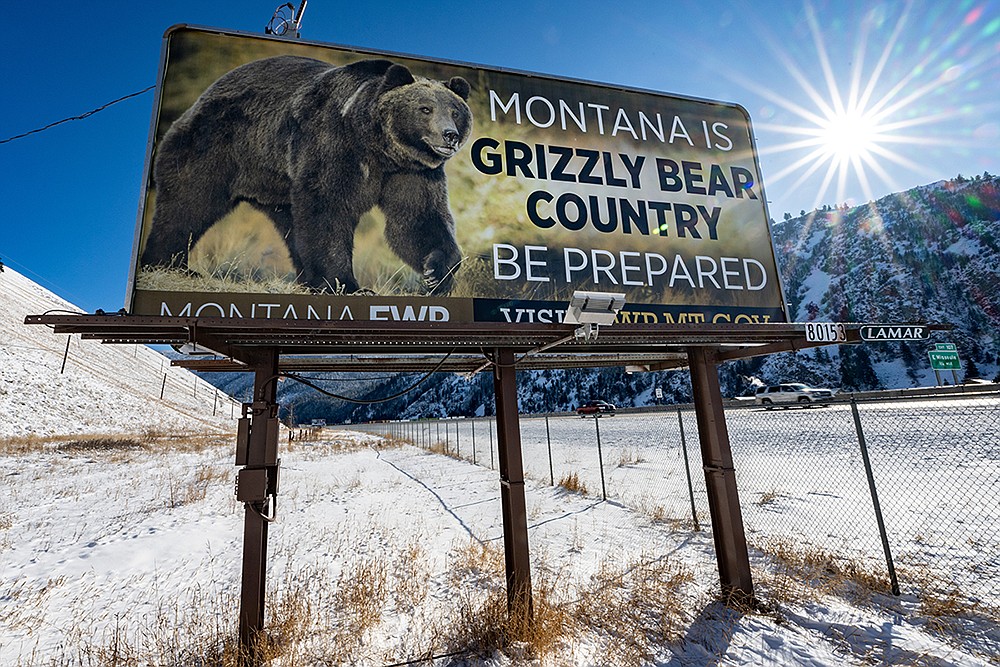
A highway billboard in Missoula reminds motorists that grizzly bears are a reality of life in the Treasure State. (UM News Service photo)
This is in response to Chris Servheen’s Dec. 21 guest opinion piece "Grizzly Bears: Living up to our heritage."
Mr. Servheen was the grizzly bear recovery coordinator for the U.S. Fish and Wildlife Service where he administered the recovery of grizzly bears in the Northern Rockies for the past 35 years.
His efforts resulted in the expansion of the grizzly population to a level that many believe qualifies the species for removal from the Endangered Species Act in at least two portions of its range – the Greater Yellowstone Ecosystem and the Northern Continental Divide Ecosystem.
However, in December 2024, Servheen submitted a report to FWS arguing that, in his opinion, grizzlies are not yet recovered and continue to need federal protection as a threatened species. Servheen contends that grizzlies in the Northern Rockies should be viewed as a single metapopulation and not as isolated islands in five distinct recovery zones in Montana.
He also maintains that regressive state laws in Montana, Wyoming and Idaho could lead to over hunting and that state governments need to impose stronger regulations to reduce man-caused grizzly deaths and stem the sprawl of homes and businesses into grizzly territory.
In February 2024, a court settlement agreement was reached that states: “On or before Jan. 31, 2026, the Service shall submit to the Office of the Federal Register a final ruling complying with the ESA and its implementing regulations that revises or removes the entire ESA listing of grizzly bears in the lower-48 United States.”
Even though a settlement agreement had been reached, the grizzly delisting issue continues to be bogged down in legal and administrative wrangling that could delay a delisting decision for some time.
State officials in Montana, Idaho and Wyoming continue to press the Fish and Wildlife Service for a delisting decision because they believe existing data clearly show that grizzlies in at least two of the recovery zones meet the criteria for delisting and they argue that the states should have the authority to manage the grizzly.
Servheen’s opinion piece soft pedals the eastward expansion of grizzlies by making the following claims that the agricultural community finds especially repugnant:
Grizzlies are not expanding into new territory; they are returning home.
The bears are gradually travelling eastward while causing almost no problems.
Most Montanans support grizzly bears. This broad support contradicts the idea that rural communities are uniformly opposed to the presence of grizzlies.
Grizzlies are slowly walking east from the Rocky Mountain Front across farm and ranch country toward their ancestral home, largely without conflict or fanfare, sustained by public acceptance.
Servheen’s cavalier assessment overlooks the negative aspects of the eastward expansion of grizzlies. One ranch family in the Dupuyer Creek area had to stop raising oats because grizzlies were frequent grazers in their grain field and they report waking up mornings to find grizzlies loitering in their front yard. A Big Sandy rancher had a confirmed grizzly kill on a calf in April 2025. Winifred has several recent confirmed grizzly sightings, including a game camera photo of a large male grizzly 10 miles out of town.
There are hunters, hikers and campers that are killed or mauled almost every year in Montana. And let’s not forget the Forest Service law enforcement official who was killed by a grizzly while he was riding a mountain bike.
The popular solution to all of this is “learn to live with bears.”
A more pragmatic approach for the farm and cattle industry would be to establish a zero bear tolerance zone in a large swath of land east of Interstate 15 to the Montana border. Servheen, however, believes grizzlies should be allowed to expand to all parts of their historic range, putting the onus on farmers and ranchers to figure out how to deal with bears that show up in their grain fields, livestock pastures and front porches.
Chris Servheen is considered to be an icon in the grizzly bear recovery effort, but advocating for grizzlies to expand into Montana’s agricultural heartland to uphold our heritage is simply wrong.
Ron Poertner is a rancher in Winifred.