
Thousands of local election ballots rejected over Montana’s new year-of-birth requirement
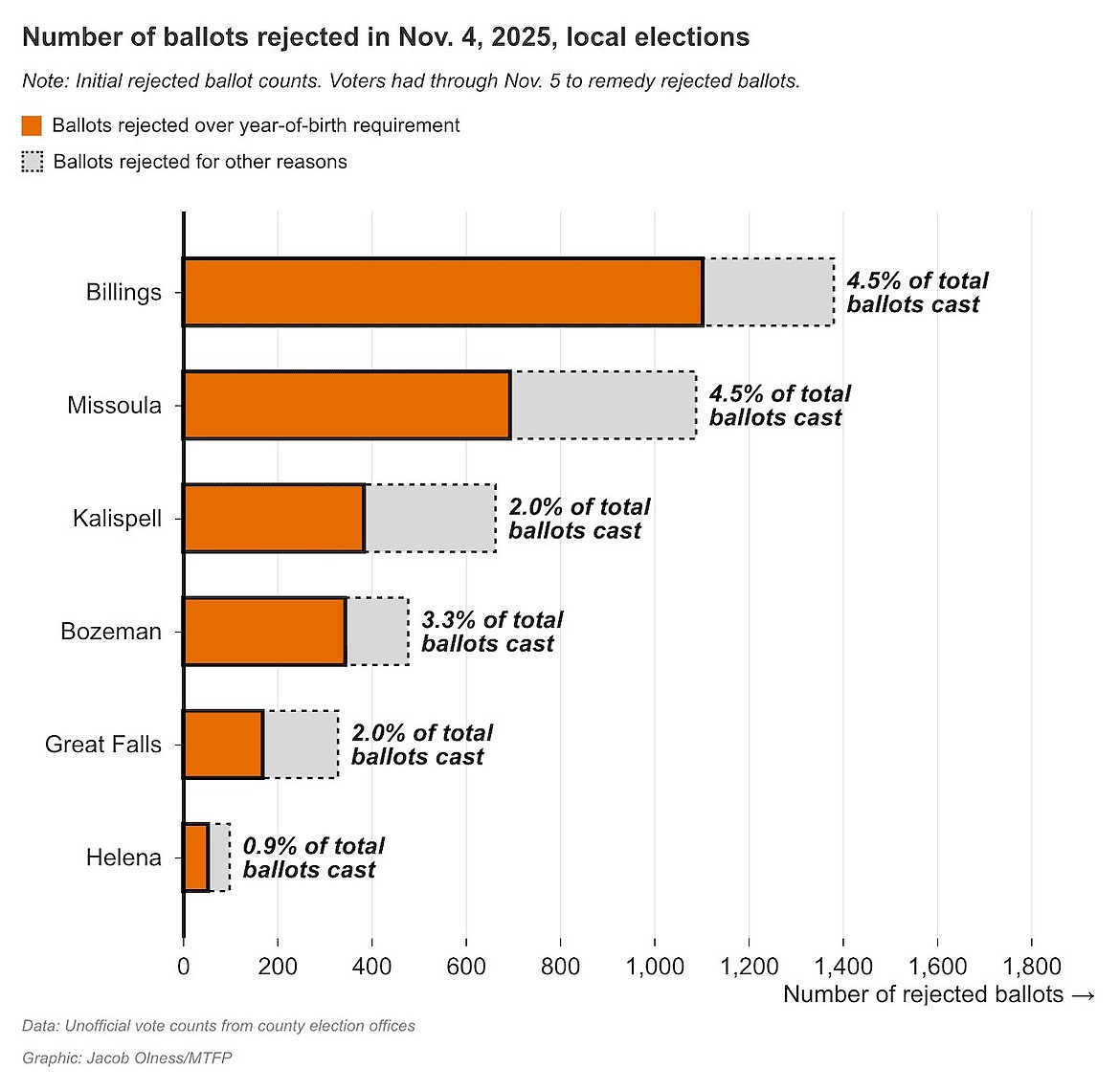
A new requirement that voters write their year of birth on mail-in ballot envelopes resulted in more than 2,700 local-election ballots being rejected this week in Montana’s six largest cities, according to election office data compiled by Montana Free Press.
Another 1,278 ballots were rejected for issues with ballot-envelope signatures, which have been a longstanding requirement. Many of those votes have since been or will be counted if voters are able to remedy the issues flagged by election workers.
Sarah Bell, Missoula County’s deputy elections administrator, said in an interview that the year-of-birth requirement resulted in a tenfold increase in rejected ballots over the county’s September primary election, which was held before the new requirement took effect.
“In the primary election, the primary from September, we had around 120 for the entire election, 120 rejected ballots, compared to this one with 1,090, so that’s such a huge increase,” Bell said.
Voters with rejected ballots in Missoula and other jurisdictions had a chance to remedy them.
Missoula County put a staffer on the issue full-time, calling, emailing and mailing voters to let them know their envelope information would have to be corrected before their votes could be counted. Additional staff was called on to help with the outreach.
Initial ballot rejection rates varied widely across the state, from as high as 4.5% in Billings and Missoula to just under 1% in Helena. The new birth year requirement accounted for about half of rejected ballots in Great Falls, Helena and Kalispell. In Missoula and Billings, it accounted for 72% and 80% of rejections, respectively.
A few races were tight enough that the rejected ballots represented enough votes to potentially have changed outcomes. In Billings, for example, where 627 of 1,381 initially rejected ballots remained unfixed and uncounted as of Election Day, the city’s mayoral race was decided by roughly 200 votes.
Lawmakers who supported the addition of the birth year requirement earlier this year argued that it would improve the integrity of mail balloting. The change was made by a bill sponsored by Rep. Braxton Mitchell, R-Columbia Falls, who laid out his arguments in a February hearing.
“When you get a prescription, they ask for your birthday, when you create an account online for websites, they ask for your birthday. When you buy alcohol, they ask for your birthday. When you vote in person, they ask for your birthday, but when you vote by absentee, that question is not asked,” Mitchell said.
“Absentee and mail-in voting are important options for many Montanans, especially our seniors, and this bill is simply bringing their verification process in line with in-person voting requirements,” he added.
The bill was supported by Montana Secretary of State Christi Jacobsen, who oversees elections. Groups representing seniors and people with disabilities opposed it, arguing the added requirement would keep some eligible voters from successfully voting. The measure passed on party lines with Republican support and Democratic opposition.
Two groups, Big Sky 55+ and Disability Rights Montana, sued the state in May, arguing that the birth year requirement disenfranchises older voters and those with disabilities. Thursday, attorney Raph Graybill said the sharp increase in rejected ballots this election validates his clients’ concerns.
“We’ve talked about the potential for disenfranchisement, but here it’s come out in the open,” Graybill said. The lawsuit, initially filed in state district court, is now pending in federal district court.
Elections offices in Missoula and elsewhere have attempted to contact voters with rejected ballots as required by law so corrections can be made and votes can be counted. Voters had until Nov. 5 to remedy issues in person or mail in corrections, which can be counted through Monday if they were postmarked by Nov. 5. Voters can check the status of their ballot at voterportal.mt.gov
Bell said Missoula County officials were able to get 55% of the initially rejected ballots corrected. Election officials in Yellowstone County provided numbers indicating they’d been able to correct ballots at the same rate. Officials in Helena said they’d been able to correct 44 of 99 rejected ballots, a 44% correction rate.
This year’s general election, which consisted of city government races, county tax measures and a handful of school bonds, involved significantly fewer voters than next year’s general election, when all 150 seats of the state Legislature and three of Montana’s four federal delegation seats will be on the ballot.
Voter turnout in the state’s six largest cities ranged from 54% in Helena, where the ballot included a hotly contested mayoral race, to 33% in Bozeman, where races for mayor, city commission and an initiative that sought to address water and housing affordability issues drew comparatively low turnout.
 (Courtesy the Montana Free Press)