
BNSF Railway fights Libby asbestos case in federal appeal
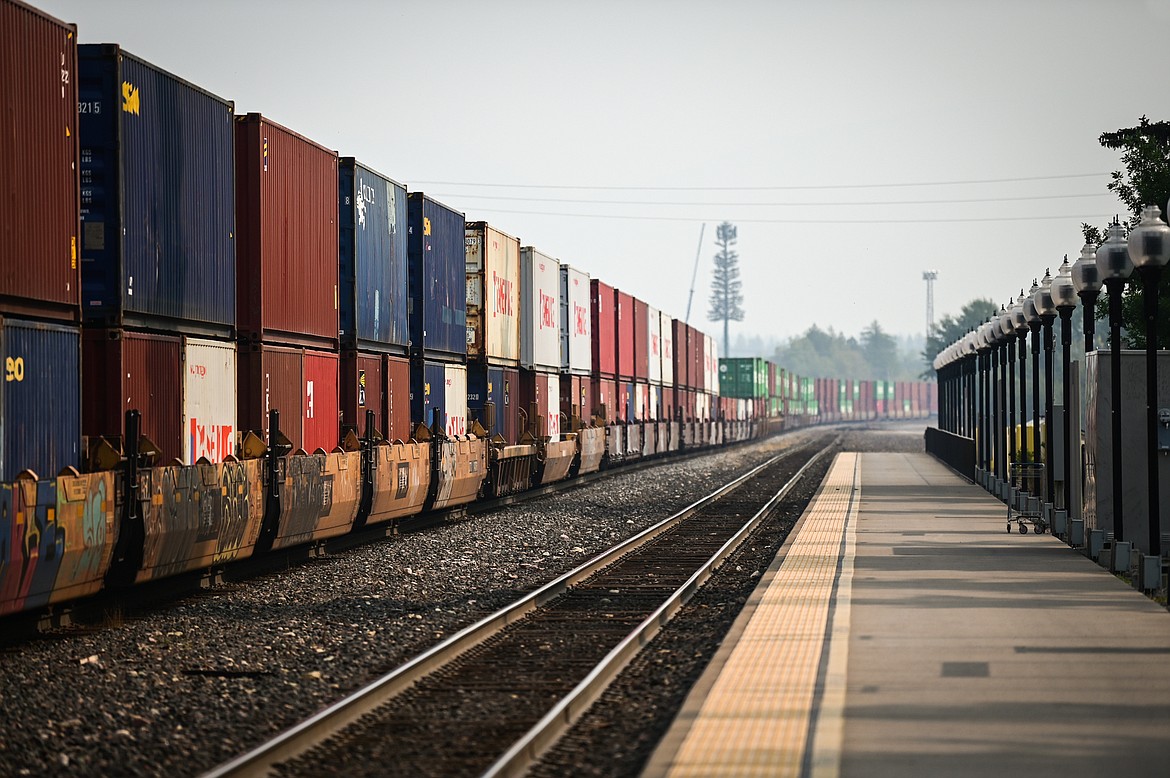
A BNSF freight train at Whitefish Depot on Wednesday, Sept. 14. (Casey Kreider/Daily Inter Lake)
A panel of federal judges on Tuesday appeared skeptical of arguments from lawyers for two deceased plaintiffs that railroad giant BNSF Railway is liable for past asbestos contamination at its rail yard in Libby.
BNSF appealed the case to the 9th U.S. Circuit Court of Appeals after a federal jury in Helena in 2024 found the company legally responsible for asbestos toxicity at its rail yard that likely caused the deaths of two plaintiffs, Thomas Wells and Joyce Walder. Both plaintiffs lived adjacent to the site decades ago and died of mesothelioma — a lung cancer often linked to asbestos exposure — in 2020.
The jury awarded each plaintiffs’ estates $4 million in compensatory damages, but did not find that BNSF had knowingly acted with negligence by failing to clean up its rail yard. BNSF, a Texas-based subsidiary of Berkshire Hathaway, has argued that mine owner W.R. Grace never notified it that the vermiculite products it was hauling were tainted with toxic asbestos fibers.
W.R. Grace, a specialty chemical company, faced thousands of lawsuits in the early 2000s after the facts about Libby’s contamination first became public. The company declared bankruptcy in 2001 and established a multi-billion-dollar trust for people injured by the company’s asbestos contamination. Seeking a trust payment does not prohibit Libby residents from also suing BNSF.
Members of the three-judge appeals panel based in Portland, Oregon, made up of Judges Consuelo M. Callahan, Morgan Christen and Andrew D. Hurwitz, raised a number of questions during Tuesday’s arguments over how the railroad could still be found liable for harm if it was not negligent. Each side had roughly 20 minutes to present its case and answer the judges’ queries.
“Your theory is that they’re subjected to strict liability for not cleaning up the asbestos off the tracks?” Hurwitz posed to Kevin Parker, one of the attorneys representing the plaintiffs.
“They are subjected to strict liability because they had an abnormally dangerous condition,” Parker replied, speaking about the rail yard.
“Well, that’s my question,” Hurwitz continued. “… Is it an ultra-hazardous activity not to clean your rails? See, it seems to me that’s a negligence theory, on which you lost.”
Judges also raised questions about how, exactly, the contamination of the rail yard site occurred. If residue was released from the vermiculite products in the normal course of transportation activities, judges said, federal law might shield BNSF from liability.
The company, like other railroads, is considered a “common carrier,” a status that bars it from discriminating against companies that need goods shipped across state lines, but also protects BNSF from actions it takes in service of that transportation.
If the asbestos contamination on the ground around the railroad lines happened during routine switching of train cars, or even from leaking from cars themselves, BNSF attorney Dale Schowengerdt said, the company cannot be held legally responsible for any harm caused.
Parker pushed back against that conclusion, pointing out that the asbestos contamination in the soil built up over decades and was not remediated by BNSF until after the creation of a federal Superfund site in and around Libby.
“The asbestos was no longer in transport when it came off the train. It’s not on its way anywhere. It’s just sitting there,” Parker said.
The judges also raised questions about how their ruling could affect approximately 200 other lawsuits filed against BNSF in the Montana state court system, which attorneys have said are waiting to proceed based on the outcome of this case. Attorneys for both sides said that the outcome would have a direct impact on a few cases pending in federal court, but would not necessarily dictate how state courts can consider other lawsuits.
Some judges weighed the possibility of a ruling that finds that the state law issues debated in this case are preempted by federal laws and regulations, including the Interstate Commerce Commission Termination Act and the Hazardous Material Transportation Act.
Schowengerdt, the BNSF attorney, appeared to endorse that possibility. He emphasized the importance of ensuring that railroad companies follow one rulebook rather than changing operations to comply with unique conditions in each state.
“Uniformity is vital to railroad operations. The railroad can’t have differing rules from state to state on how it runs the rail yard, how it improves its equipment,” Schowengerdt said.
The court will likely not rule on the case for several months. If the appellate court reverses the jury’s findings about the railroad’s liability, the plaintiffs’ $8 million award from 2024 could become nothing.
READ MORE:
Libby's asbestos clinic shuttered after losing lawsuit to BNSF Railway
Feds join fight to reopen asbestos clinic in Libby
Federal judge ponders future of Libby's asbestos clinic
Feds suggest removing Libby, Troy from national list of most contaminated places
Critics warn bills would let BNSF Railway off the hook in asbestos-related suits
BNSF accuses Libby health clinic of submitting false asbestos claims
Jury: BNSF Railway contributed to 2 deaths in Montana town where asbestos sickened thousands
Asbestos victim's dying words aired in wrongful death case against Buffet's railroad
Jury says Libby health clinic submitted 337 false asbestos claims
Supreme Court rules BNSF ‘strictly liable’ for asbestos injury claims