
Democratic candidates emphasize ranch roots and military experience in Montana’s western House primary
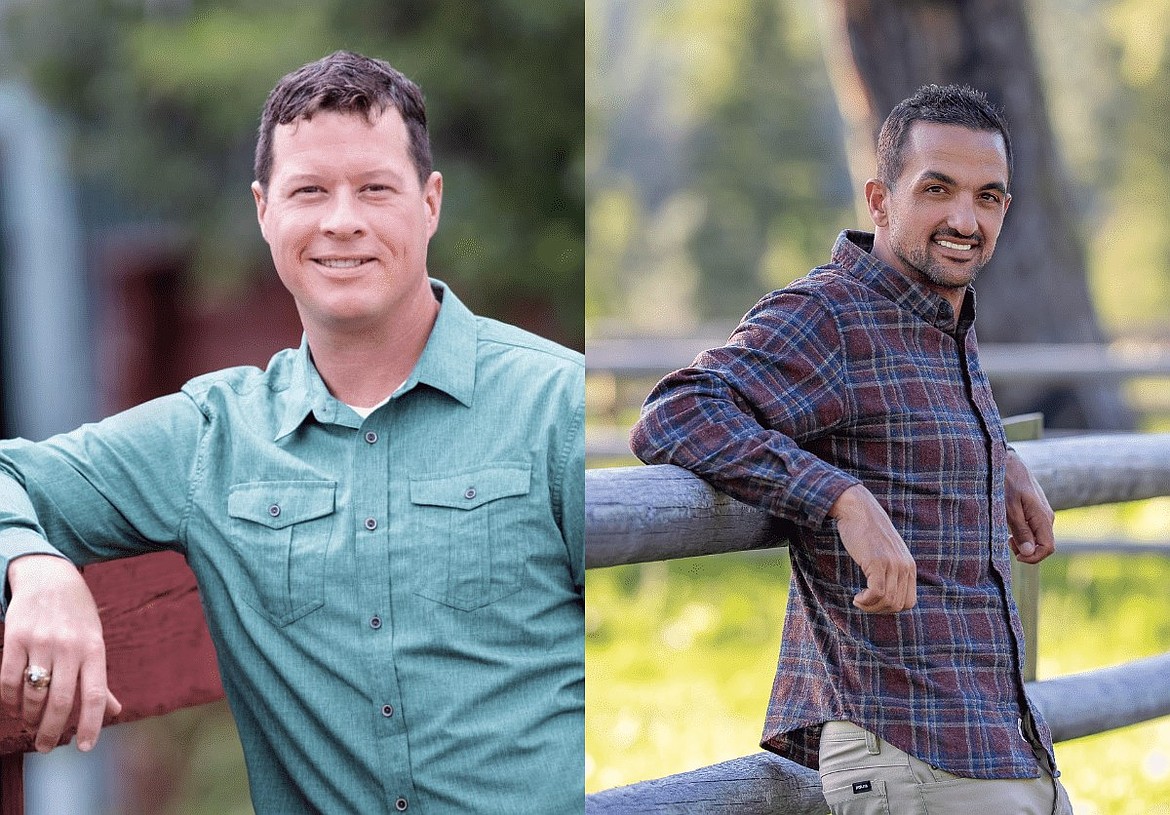
Democrats Matt Rains, left, and Russell Cleveland, right, are running in Montana's western House primary. (Photos provided by the candidates)
Things are about to get unusually western for Democrats in Montana’s more competitive U.S. House seat.
One month after pledging to fight for more of the state’s rural vote, Democrats have fielded not one but two western House district candidates with ranch roots and military experience.
Russell Cleveland, 40, of rural Stevensville, who has been a candidate since March, drew a challenger Thursday in Simms native Matt Rains. Both tout ranching family roots and Republican parents. Cleveland is a former aviation electrician in the U.S. Navy. Rains is a West Point graduate and Army Black Hawk helicopter pilot.
Cleveland lives on a ranch property near St. Regis. Rains, 45, lives on a production livestock ranch near Simms, which isn’t in the western district. Members of the House don’t have to reside in the district they represent.
If Montana voters have a type, rural and veteran could be it. Three of the four Republicans who comprise Montana’s congressional delegation are veterans. In the 2024 U.S. Senate race, Republican political newcomer Tim Sheehy, a Navy veteran who owns a cattle ranch, defeated Democratic former U.S. Sen. Jon Tester, a dryland farmer who had prevailed in three previous elections despite winning more than 50% of the vote only once. Tester was the last statewide Democrat officeholder in Montana when he lost that race.
The one non-veteran in Montana’s federal delegation currently is two-term U.S. Sen. Steve Daines, who is on the ballot in 2026.
“No, I don’t think we have a type,” Rains said of Montana voters. “Ten percent of the population are veterans of some degree or another. So, I mean, it’s probably one of the most identifiable components of who we are as Montanans. So, it’s important. But in terms of the type, no, I mean calling yourself a veteran, I mean, that’s a huge spectrum.”
The western U.S. House district race is likely to be the state’s most competitive federal race of 2026. Cleveland in town hall meetings and Rains’s introductory literature tell voters that Tester prevailed in western Montana in his 2024 bid while losing the state as a whole by 43,000 votes.
“He won this district. So, he didn’t lose it all,” Cleveland told a Bozeman audience in late September. In rural Montana, Cleveland tells his audience that even in the more urban western part of the state, agriculture matters.
“So, we still have a huge agricultural presence, especially in southwest Montana. Dillon and places like that, huge cattle ranches. So, it still impacts us, maybe not to the extent of eastern Montana, but public lands play into that, too,” he said.
State election data shows Tester picking up 1,729 more votes than Sheehy in the 16 counties of the western U.S. House district and 49.4% of the district’s vote overall, with Green Party and Libertarian candidates making up the difference.
The 2024 western district House race between incumbent Republican Ryan Zinke and two-time Democratic challenger Monica Tranel was less competitive, with Zinke picking up nearly 25,000 more votes, a 7-percentage point advantage. Support for the Republican was better in 2024 than in 2022, the first year the newly created district was on the ballot.
Appealing to rural voters was a recurring message at a recent state Democratic Party convention in Livingston last month. Tester phoned in to caution against focusing on “blue districts.”
“The Democratic Party is in trouble. We have done it to ourselves. We have focused on blue districts and not on other districts throughout the state,” Tester told conventioneers. “We are seen in polling as woke and weak.”
The party’s new chair, former Missoula state senator Shannon O’Brien, said “We don’t just provide lip service for our rural Democrats, we really travel, go out, and get to them — listen to them — and recruit candidates.”
The trend in Montana Democratic candidates for U.S. House has long been not only urban, but female. Ten of the party’s 16 general election candidates for U.S. House since 2000 have been women, who took some of the most bruising outcomes in Montana statewide elections. Montana’s eastern House district favors Republicans by as much as 20 points.