
Why litigation matters for Montana’s water future
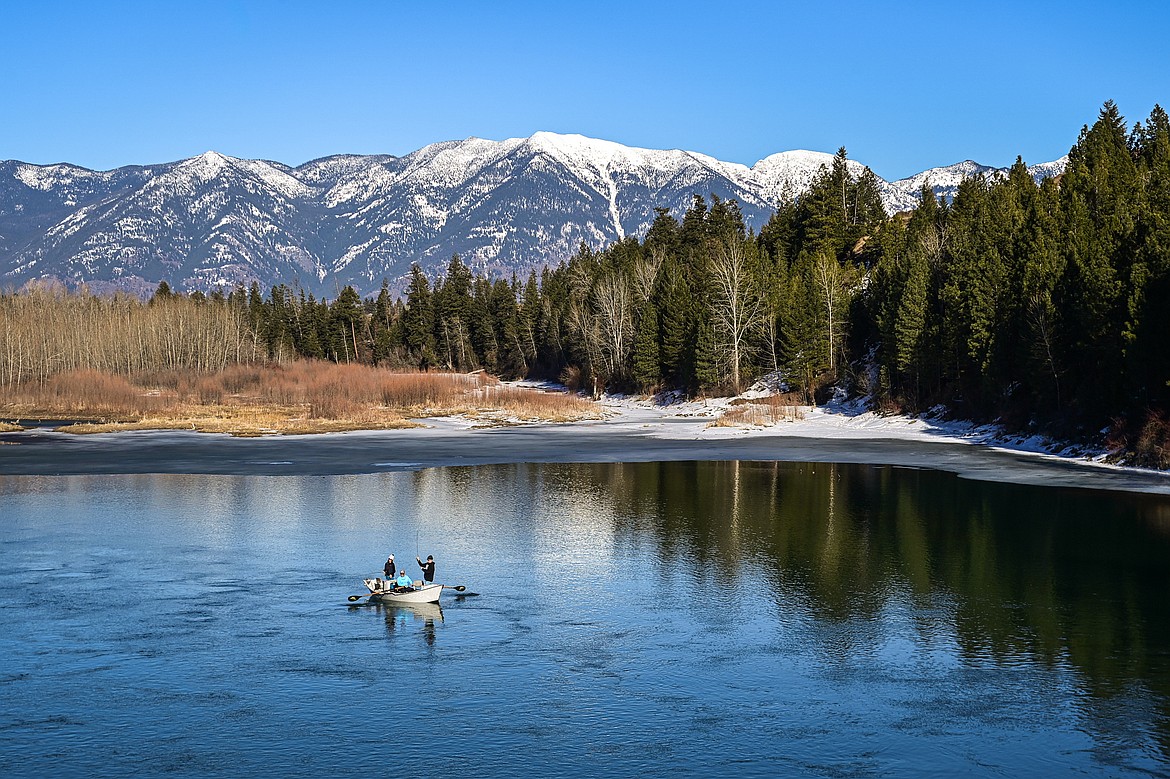
Three anglers fish from a boat on the Flathead River on Saturday, March 1. (Casey Kreider/Daily Inter Lake)
Casey Kreider
Recent op-eds argue against litigation as a mechanism to protect our rivers and water rights. They claimed that litigation supporting instream flows for river health limits state agency flexibility and that collaborative watershed solutions are the way forward.
I disagree: Collaboration cannot stand alone in the protection of our rivers and rights; the legal fight continues.
Over my 40 years working as a professional in natural resources management, I developed and managed several programs promoting watershed efforts and operations. Indeed, collaborative watershed efforts can provide measurable improvements.
Where recent opinion pieces miss the forest for the trees is collaborative efforts are built on a framework of laws protecting our rivers and our rights. Litigation forged that framework by defining our rights and protecting our water resources in the courts.
Consider the critical role the state’s Natural Resources Damage Program litigation plays in watershed remediation and restoration. Litigation filed by the state against ARCO in the Clark Fork Superfund case (1983) resulted in hundreds of millions of dollars in investment in watershed remediation and restoration, including grants for locally sponsored watershed restoration. Litigation against ASARCO (2008) provided agency funding to remediate legacy-mining contamination at the top of the Blackfoot River watershed.
The Milltown water right, co-owned by Fish, Wildlife and Parks and the Confederated Salish and Kootenai Tribes, is at issue in current litigation over the protection of instream flows and the public trust. The Milltown water right’s ownership is the outcome of two hard-fought legal settlements: the Clark Fork restoration settlement with ARCO and the CSKT water right compact and settlement.
One need only look to seminal Montana Supreme Court case law to discern the invaluable role litigation plays in defining the work-space in which watershed collaborations operate:
Stream Access: Montana Coalition for Stream Access v. Curran, 1984 established the public’s right to access our rivers and formed the basis for Montana’s Stream Access Law, the strongest in the nation;
Clean and Healthful Environment: MEIC, et. al. v DEQ, 1999 resulted in Montana’s Supreme Court recognizing individual constitutional rights for Montana citizens to a clean and healthful environment;
Watershed Protection: Friends of the Wild Swan v. EPA, 1999 compelled EPA and Montana DEQ to complete watershed assessments documenting pollution sources and required clean-up plans for all impaired streams;
In-stream Flow Protection: Trout Unlimited et. al. v DNRC, 2005 forced the agency to recognize best available science proving that ground and surface water are a single resource and must be managed as such.
Water Rights: Clark Fork Coalition v. Tubbs, 2016 struck down DNRC’s “combined appropriation” rule that allowed sprawl development to use the ‘exempt well loophole’ and avoid the water permitting process. A subsequent Montana Supreme Court order, and a second round of litigation, in Horse Creek Hills, further curtailed the government from allowing unregulated development through the use of the exempt well loophole.
Litigation continues to be necessary. Upper Missouri Waterkeeper et. al. v. Fish, Wildlife and Parks 2025, is a critical test that will define the extent of the public trust doctrine in Montana. In Upper Missouri Waterkeeper v. DEQ (2023) and (2025), litigation challenging massive new development and the state laws incentivizing septic pollution adjacent to the Gallatin River highlights other vital efforts we are taking to protect keynote Montana rivers from further water quality degradation. Last but not least, Upper Missouri Waterkeeper v EPA (2015, 2020, 2022) and ongoing efforts challenging the rollback of numeric nutrient standards demonstrates the necessity of litigation to retain science-based standards capable of meaningful and measurable water pollution control.
At the Oct. 23 Water Policy Committee meeting Senator Curdy asked DNRC’s Water Resources Administrator about recent Idaho legislation greatly restricting Idaho’s ground water loophole:
Senator Curdy: “… politically there had to be something that really prompted this … what pushed this along?”
Administrator Pakenham Stephenson: “… there was a tremendous amount of litigation on the Snake plain …”
Let's be clear: Public-interest litigation benefits all Montanans. It compels agencies to follow the law, directs lawmakers towards constitutional paths, and establishes the legal framework within which effective watershed collaboration occurs. Litigation is needed to restore our rivers and protect our rights.
Upper Missouri Waterkeeper is a donor-supported nonprofit. We rely on community members who value clean water to help us bring these cases and defend Montana’s Constitution. Without public support, this critical work will not happen. Join us! Your support ensures Montana’s rivers remain fishable, swimmable and drinkable.
John E. Tubbs is chair of the Upper Missouri Waterkeeper, former director of the Montana Department of Natural Resources and Conservation, and former deputy assistant secretary for water and science at the Department of Interior.