
Litigation is not collaboration
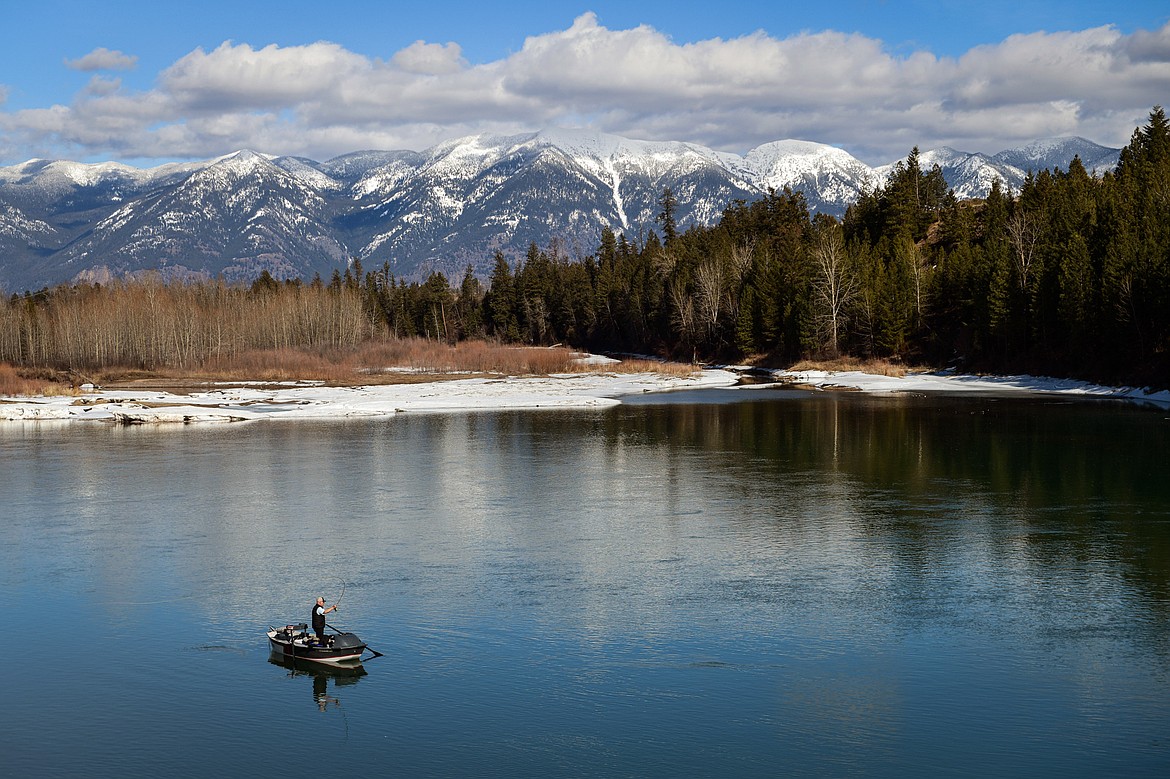
Gary Emmert fly fishes from his boat on the Flathead River on Thursday, March 14. (Casey Kreider/Daily Inter Lake)
Casey Kreider
I am in total opposition to the recent editorial by John E. Tubbs (Why litigation matters for Montana’s water future, Jan. 4) advocating litigation as a primary tool for water policy in Montana.
While courts have an important role, governing by lawsuit is not collaboration — and it is not how a representative democracy is supposed to function. When unelected nonprofits, administrators and lawyers (funded by out of state mega donors) repeatedly drive policy through litigation, the costs fall not on abstract “systems,” but on local governments, rural utilities, ratepayers, landowners and taxpayers.
Those costs are not theoretical.
Defending a single environmental or water-rights lawsuit routinely costs $500,000 to $2 million for a state agency or local government once staff time, expert witnesses, consultants and attorneys are included. Multi-year cases can easily exceed $5 million — even when the government ultimately “wins.” Those dollars do not come from thin air. They come from utility rates, delayed maintenance, deferred infrastructure or higher taxes.
For small and rural water or wastewater systems, the impacts are even more severe. Many rural Montana utilities operate on annual budgets of $300,000 to $1 million. A single lawsuit or consent decree can force capital upgrades costing $2–10 million, often financed through debt. That translates directly into 20–50% rate increases for customers — farmers, retirees, and working families least able to absorb them.
The Big Sky Water and Sewer District was sued in environmental and related litigation, including federal Clean Water Act claims, and the district prevailed. A December 2025 Explore Big Sky article noted that legal defense expenditures had reached approximately $3.4 million, affecting roughly 3,500 district ratepayers and contributing to rate increases and reserve draws.
These are not polluters. These are towns trying to keep water running and sewage treated.
Mr. Tubbs frames litigation as a public good that “benefits all Montanans.” But litigation-driven governance benefits one group consistently: lawyers and advocacy organizations. Meanwhile, counties face permitting paralysis, cities delay housing projects and utilities are forced into compliance schedules that ignore local conditions, engineering realities and affordability.
Collaboration cannot exist when one party holds a lawsuit over the table as leverage. That is not partnership — it is coercion. Real watershed collaboration in Montana has historically come from negotiated compacts, basin planning, infrastructure investment and voluntary conservation — not perpetual court supervision.
There is also a deeper constitutional issue. Policy outcomes are increasingly dictated not by legislators accountable to voters, but by court rulings shaped by a small number of ideologically aligned judges. When agencies operate primarily to avoid being sued, flexibility disappears and common-sense solutions give way to defensive bureaucracy. Innovation stops. Costs rise.
Montanans value clean water. They also value affordability, private property rights and local control. These values are not in conflict — unless litigation is elevated from a last resort to a governing philosophy.
Courts exist to resolve disputes, not to serve as permanent policy engines. When environmental policy is repeatedly imposed through injunctions rather than legislation, public trust erodes — and rightly so.
Protecting rivers does not require empowering unelected entities to govern by lawsuit. True stewardship comes from laws debated openly, passed by elected representatives and implemented transparently — with collaboration that is voluntary, science-based and economically realistic.
Litigation should remain a tool of last resort, not the default mechanism of governance.
Marc A. Liechti is Lakeside County Water and Sewer District board president, and owner of APEC Engineering in Somers.