
Kalispell adopts public engagement plan updates, hears status of Crisis Assistance Team
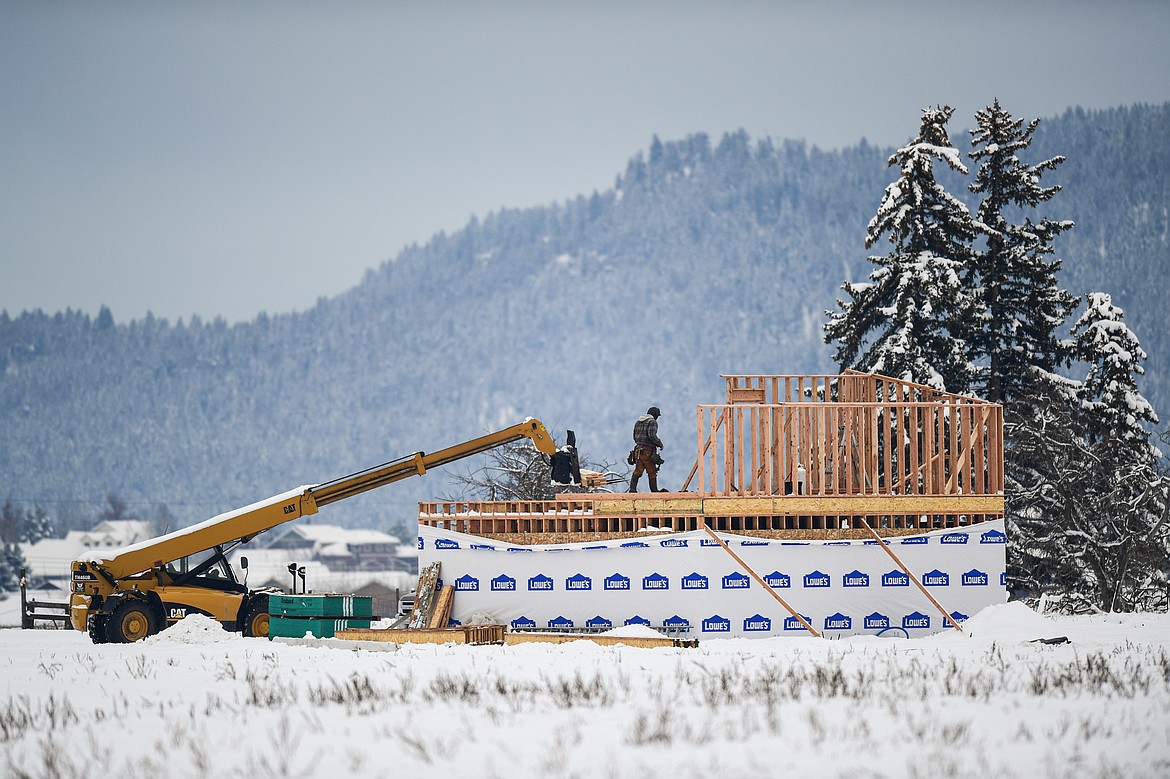
A builder works on a home along Farm to Market Road on Wednesday, Dec. 3. (Casey Kreider/Daily Inter Lake)
Casey Kreider
City Councilors on Monday lauded Kalispell’s updated public participation plan, saying it could serve as a model for other Montana municipalities looking to keep residents informed on future development.
Council unanimously approved the changes and also heard an update from Flathead County Behavioral Health Supervisor James Pyke on the operations of the Crisis Assistance Team.
The revamped public participation plan clarified how residents can stay informed on development proposals after a state law scrapped public hearings on proposed subdivisions, conditional use permits and variances. Annexations and zoning map changes will still wind through the standard public hearing process.
“What we were trying to do was have the most robust public engagement that we could have within the parameters of [the Montana Land Use Planning Act] itself,” said Development Services Director PJ Sorensen.
One change creates an online portal for the public to access developers’ application materials and any determinations by staff. The website would include information on written public comment windows and how a given proposal can be appealed.
Residents can also subscribe to email notifications to alert them to public comment periods and guide them to staff reports.
“I think that we came up with a really good product which I actually think would hopefully be inspirations for other cities,” said Councilor Kyle Waterman.
“This is a great step. I look forward to seeing it in action and seeing if there’s any refinement we can do along the way,” agreed Councilor Dustin Leftridge. “This is a great model and it should be utilized everywhere.”
The Montana Land Use Planning Act, passed in 2023, was designed to streamline housing construction. It required larger Montana cities to shift subdivision approvals to city staff, ending the Planning Commission and Council review process. Residents will still have a window to submit written comments and can appeal decisions made by planning staff, a process that begins with the city’s Development Services Department.
Zoning and subdivision proposals will continue to be posted in a local newspaper, and letters will still be mailed to property owners within 150 feet of a proposed development.
FLATHEAD COUNTY Behavioral Health Supervisor James Pyke told Councilors on Monday that the Crisis Assistance Team is leading the state in service despite funding shortfalls.
“Flathead County isn’t being left behind. In many ways we’re leading in crisis care, even though it doesn’t look like it,” Pyke said. “There isn’t a great model in other places that has really shown a way forward using the funding allocations from the state the way they’re laid out.”
Across Montana there are just five mobile crisis response teams, which Pyke called scarce. There are also only three crisis stabilization facilities statewide, two of which operate 24 hours a day, seven days a week.
While a 24-hour crisis facility in Flathead County would be ideal, Pyke said there isn’t enough funding to operate one.
State grants could support a facility for 18 months, but after that Medicaid reimbursements would be unable to cover the operational costs, according to Pyke.
The one-time and two-time grants that are doled out “inevitability face funding cliffs that kill services,” Pyke said.
The Crisis Assistance Team launched in August 2020 to reduce the frequency of 911 calls related to behavioral health issues. The mobile crisis response team consists of two clinicians and three care coordinators. One of each is paired to respond to calls, which are most often routed through the 911 dispatch center.
In 2025, the team served 450 unique individuals and had 1,455 individual encounters — 540 of which warranted responses in their company vehicle. The average time they spent on the scene was 50 minutes.
To reach more remote areas of the county, the team also provides support by phone. However, Pyke said he wants to avoid replacing Montana 988, part of the National Suicide Prevention Lifeline. He said the crisis team could not handle its volume of nearly 300 calls per month in Flathead County alone.
The Crisis Assistance Team is funded primarily by the Montana Opioid Abatement Trust (60%), with 20% coming from Medicaid reimbursements. The rest is funded through grants.
After a third clinician is onboarded, Pyke plans to base a pair of service providers in the northern part of the county to more quickly respond to calls there. The bulk of the calls still come from Kalispell’s urban center, though, he said.
Mayor Ryan Hunter and Councilors Sam Nunnally and Lisa Blank expressed their support for the service. They said they would help lobby for state funding programs that would benefit operations.
FIREFIGHERS RYAN Caterino and Eric Woodruff were met with a standing ovation after being confirmed to the Kalispell Fire Department on Monday night.
Reporter Jack Underhill can be reached at 406-758-4407 or junderhill@dailyinterlake.com. If you value local journalism, pledge your support at dailyinterlake.com/support.