
Kalispell City Council moves forward on housing board, development standards along Parkline trail
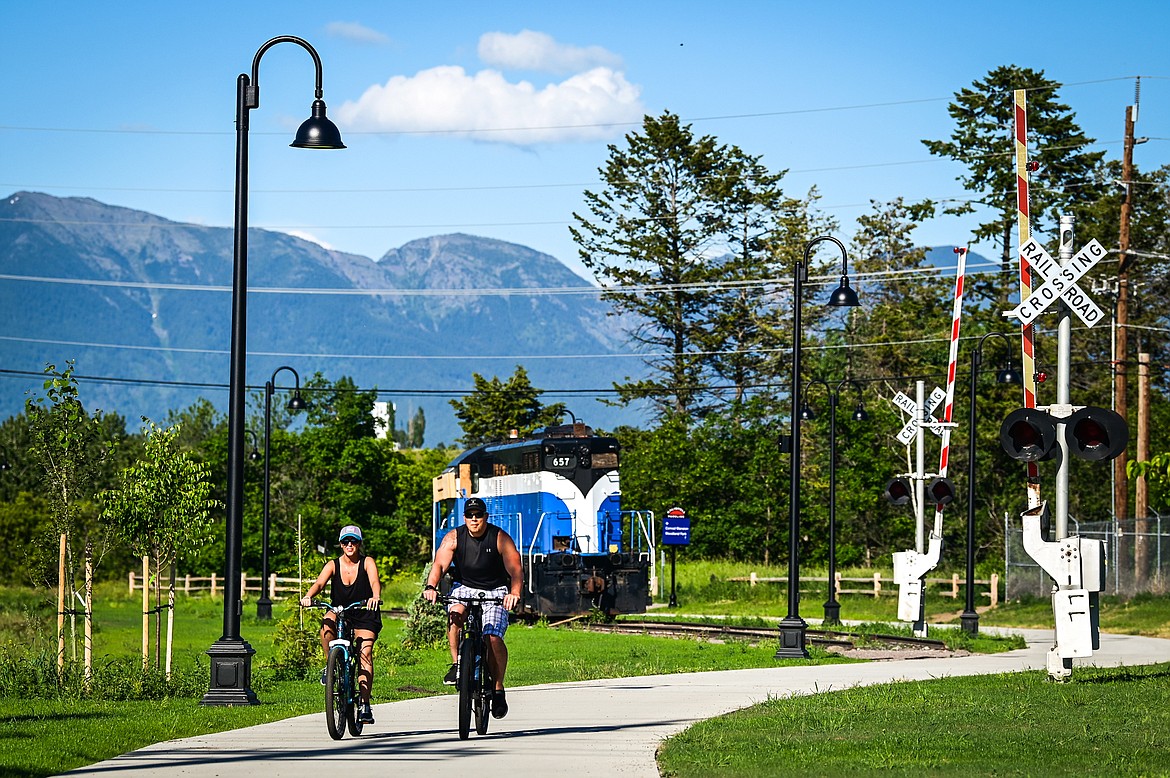
Bella Lauber and Jacob Sherwood ride bikes along the Parkline Trail in Kalispell on Tuesday, July 5. (Casey Kreider/Daily Inter Lake)
City councilors narrowly agreed to move forward Monday on two housing-related initiatives championed by Kalispell Mayor Ryan Hunter.
Council agreed to hold a future vote on creating at least a temporary affordable housing advisory board. It also asked the Kalispell Planning Commission to consider design standards for future development along the Parkline Trail.
Heading into Monday’s work session, Council planned to debate using city-owned property for affordable housing and dig into the state of short-term rentals in Kalispell, but discussion on those topics was postponed as the hour grew late.
Hunter shared his vision for a seven-person advisory board filled with affordable housing experts that can make recommendations to Council.
He said the board could help the city prepare a request for proposal for a citywide housing study. Staff has planned to conduct a study since the city received a $126,000 grant in 2023 from the U.S. Department of Housing and Urban Development to fund it.
“It would be great to have a committee that would weigh in and provide some input,” he said.
But Councilors Sam Nunnally and Jed Fisher appeared hesitant to invest time and resources into forming a committee when there were already housing nonprofits and federally funded groups dedicated to addressing the issue.
“It seems like this is our job, and there’s plenty of people to come to us. They're already out there. They need to get together and come visit,” Fisher said. “I think we are pretty good about hearing ideas.”
Councilor Wes Walker argued that an advisory board is long overdue, and that it’s the city’s responsibility to facilitate conversation with outside groups.
“I think we need to take the step and reach out and be the adult voice in the room if we have to be, so to speak, and start these conversations,” he said.
Unlike Montana’s entitlement cities — those with a population above 50,000 — Kalispell does not receive federal funds to hire an employee dedicated to housing, said Councilor Kyle Waterman.
“I feel if we wait until we’re at 50,000 [people], then we’re definitely going to be behind the eight-ball on the conversation,” Waterman said.
While Hunter envisioned a permanent board, Councilors Sid Daoud and Lisa Blank asked that it start out with a goal and timeline.
“If you don’t have a committee with a mission and a time frame and delivery, it’s just chatting,” Blank said.
Kim Morisaki, executive director of the Northwest Montana Community Land Trust, told councilors that several groups are working to expand affordable housing across the valley.
The nonprofit, established by the city in 2009 with a federal grant, buys property and keeps ownership of the land while selling the homes at below-market prices. By removing the cost of the land, it makes the homes more affordable.
Affordable housing is housing in which the occupant pays no more than 30% of gross income for housing costs, including utilities, according to the Department of Housing and Urban Development.
Up until 2020, Kalispell had 52 homes bought with grant money and considered affordable housing. Since then, 20 additional homes have been added to the inventory, according to Morisaki.
Morisaki invited collaboration with the city to ensure that units expected to lose their subsidy in the coming years will continue to be sold at below the market rate.
HUNTER ALSO received narrow support to explore tacking design standards on new development along the Parkline Trail. He said he wanted to impose similar standards to those placed on Main Street meant to preserve the historic structures.
The standards provide a “more walkable downtown, more engaging facades, more engaging buildings for the pedestrian, that would work really well for the Parkline Trail,” he said. “Nothing could kill the Parkline Trail quicker than lining it with parking lots.”
Hunter wants to see four- to five-story, mixed-use development along the trail, where much of the surrounding property is already zoned B-3 (Core Area Business) and allows that height with a conditional use permit.
The zoning designation was recommended in the city’s Core Area Plan adopted in 2012 to provide more leniency to developers and foster construction, according to City Manager Jarod Nygren.
Daoud warned that standards could hinder development and raise costs.
“I’m really hesitant about diving into this without some assurances that we’re not going to be ... putting a burden on people that want to have a business or a multifamily [development] along the Parkline Trail,” Daoud said.
Siding with Hunter, Walker said the trail was too valuable to not impose guardrails.
“We should set a floor of how we want this to be built,” he said.
In a 5-4 vote, Councilors opted to send the issue to the Planning Commission to eventually provide a recommendation to Council on what the standards could look like.
Reporter Jack Underhill can be reached at 406-758-4407 or junderhill@dailyinterlake.com. If you value local journalism, pledge your support at dailyinterlake.com/support.