
A Montana Modernist View of the West exhibit features the work of Marge Dodge
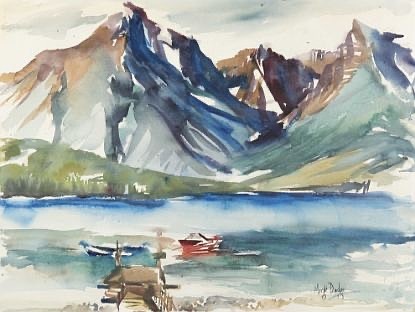
Swiftcurrent Lake in Glacier National Park by Marge Dodge.
The Phillips Gallery, in collaboration with the descendants of Marge Dodge, has put together a collection of works from the Missoula-based artist in a new exhibit, A Montana Modernist View of the West.
These works have not been available to the public for collecting since her death more than 20 years ago. Several pieces from this exhibit were recently displayed at the Glacier Art Museum in Kalispell and some pieces have not been on public view since her death.
For Chris LaRoche, these paintings tell the story of his grandmother’s life. Dodge was charismatic, a flamboyant artist and socialite, yet LaRoche felt he didn't understand the full picture.
“This project is the culmination of a lifelong, personal quest to understand this enigmatic person in my life,” LaRoche said. “I knew the artist as my grandmother, and we were close, but she was still a mystery. Her art has helped unravel a complex character.”
Marge Dodge (1918-2003), was born Marguerite Gilbertson in 1918 in Stoughton, Wisconsin. She won a scholarship after high school to attend Layton School of Art in Milwaukee. Now defunct, the school was then considered one of the top five art schools in the country.
There, she formed a four-artist partnership called the “Easelists,” who traveled around the Midwest doing portraits. After marrying Rodney Dodge in 1942, she moved with him to the deep South, studying art at the Atlanta Art Institute and raising two children in Savannah. In 1955, she brought her talent to Missoula, where she resumed her academic career at the University of Montana, completing a Bachelor of Fine Arts, a Bachelor of Arts and Master of Arts in art. For her thesis, she experimented with encaustic painting, a complex and technical process of painting with hot wax. She collaborated with Rudy Autio and Peter Voulkos to create fine art ceramic sculptures.
Her art shifted seismically as her personal life slipped out of her control. In the 1950s, her husband was at the top of his field, the world’s leading authority in the field of entomology. As the years went by, he suffered from increasingly frequent mental health episodes. A late diagnosis of schizophrenia provided answers but no solutions.
This turmoil in Marge Dodge’s personal life can be seen in the work she produced during her husband’s schizophrenic episodes as she turned to unorthodox colors and imaginary subjects to convey her emotions on the canvas. Art was how she communicated and coped through this period of her life until her husband took his own life in 1973.
When LaRoche looks at the paintings from that time, he sees the specter of his grandfather. Those painful years haunted his grandmother’s work.
“It’s not just her experimenting,” LaRoche said. “It’s her representing a difficult moment in her life.”
In a recurring series featuring blue trees, Marge Dodge painted desolate backdrops and shadowy figures. LaRoche sees the hardship she experienced as she watched her husband slip away, but in the soft glow of the sun shining through abstract leaves, he also sees a quiet resilience.
In addition to the local art community in Missoula, the artist was active across the state. She was a founding member of the Montana Institute of the Arts and formed a fine arts group that encouraged and supported local artists.
Her paintings have been selected to travel throughout the state as selections from the annual Festivals of the Arts. She had one-person invitational shows in Atlanta, the Hockaday Art Center in Kalispell and Reeder’s Alley in Helena. Her work on historically significant places was acquired by the DeKalb County Library Art Gallery in Greater Atlanta. Several of her illustrations can be found in Missoula Valley History. Her paintings are in private and public collections in the Middle East and the U.S.
The award-winning artist was a trailblazer for female artists in Montana, especially modernist artists at a time when few women did such things. Though not as widely known as some of her peers like Frances Senska and Jessie Wilbur, they were her contemporaries and friends. They were all instrumental in the foundation of the Montana Modernist Art movement.
Her work stands out in its variety and breadth across mediums and styles: drawing, painting, watercolor, oil, pottery, encaustic, collage, landscapes, portraits, dark abstracts to whimsical cut outs and silhouettes — the diversity met with technical mastery.
The exhibit will be on display through June 27. The gallery, located in the Kalispell Center Mall, is open from 11 a.m. to 5 p.m. Wednesday through Saturday. For more information, call 406-309-2335.