
Montana Supreme Court upholds housing reform laws
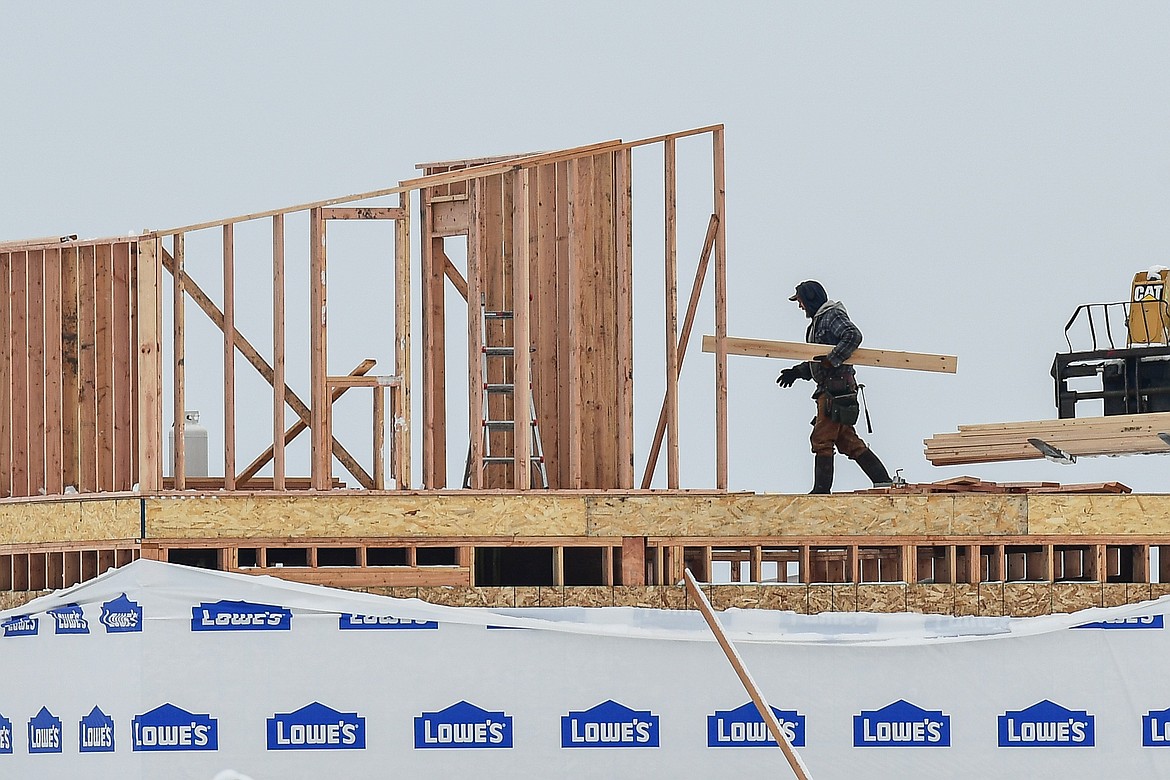
A builder works on a home along Farm to Market Road on Wednesday, Dec. 3. (Casey Kreider/Daily Inter Lake)
Casey Kreider
The Montana Supreme Court on Tuesday upheld a slate of pro-construction housing laws that were proposed by a housing task force established by Gov. Greg Gianforte and enacted by the Legislature in 2023.
Justice Beth Baker authored the 34-page opinion, which was unanimous among the court’s seven justices.
In a press release Tuesday evening, Gianforte called the court’s finding “a landmark victory.”
“By upholding the constitutionality of our reforms, it will help bring the American dream into greater reach for Montanans across our state,” he said.
In 2023, a bipartisan group of state lawmakers passed several laws that make it easier to build new homes, especially higher-density development inside larger cities. Months later, a Bozeman-based group of homeowners, called “Montanans Against Irresponsible Densification,” sued the state, alleging that the housing laws violated Montana’s Constitution.
The lawsuit, originally filed in the state district court that covers Gallatin County in Dec. 2023, targeted four state laws:
- Senate Bill 382 created the Montana Land Use Planning Act, which requires municipalities of 5,000 residents or more in the state’s urban counties to plan for the housing they need to accommodate population growth. It also focuses resident input on high-level planning discussions, making it harder for “not in my backyard”-style opposition to derail projects.
- Senate Bill 245, which forces cities of 5,000 residents or more to allow apartment-style housing in most areas set aside as commercial zones.
- Senate Bill 323, which requires cities with 5,000 residents or more to allow duplex housing on any home lot.
- Senate Bill 528, which requires cities to adopt regulations allowing more construction of accessory dwelling units, or secondary housing structures that share parcels with larger homes.
In district court, Montanans Against Irresponsible Densification, or MAID, argued the laws would force people to live in more densely populated areas with larger buildings and more traffic. They alleged the laws represented state overreach in development and planning, which is typically under local government control. They also argued that some neighborhoods would be disproportionately affected by the laws, and that the reforms violated the state constitution’s right to participate in government.
A district court judge in Bozeman last March ruled against most of the claims made by the homeowners group but concluded that provisions in the Montana Land Use Planning Act did violate the Montana Constitution’s participation right. The split ruling was jointly appealed to the Montana Supreme Court.
In its Tuesday ruling, the Supreme Court reversed part of the district court’s ruling and found that the Montana Land Use Planning Act did not violate the state Constitution’s right of participation. While MAID argued the law limited public input, the court found that it allows for public participation, particularly in the early stages of development and planning.
“We conclude that MAID has not met its heavy burden to show that Senate Bill 382 is unconstitutional in all of its applications,” the court’s opinion reads.
The court also rejected MAID’s claims that the new laws violated the Constitution’s equal protection clause. While MAID argued that the reforms disproportionately affected larger cities and neighborhoods not protected by covenants, the Supreme Court found that MAID “has not met its burden” of proof on that front.
While Senate Bill 245 was nominally part of the appeal, the court did not weigh in on that law, saying that MAID’s claim of unconstitutionality was not developed.