
Counting machines add vote of confidence to elections security
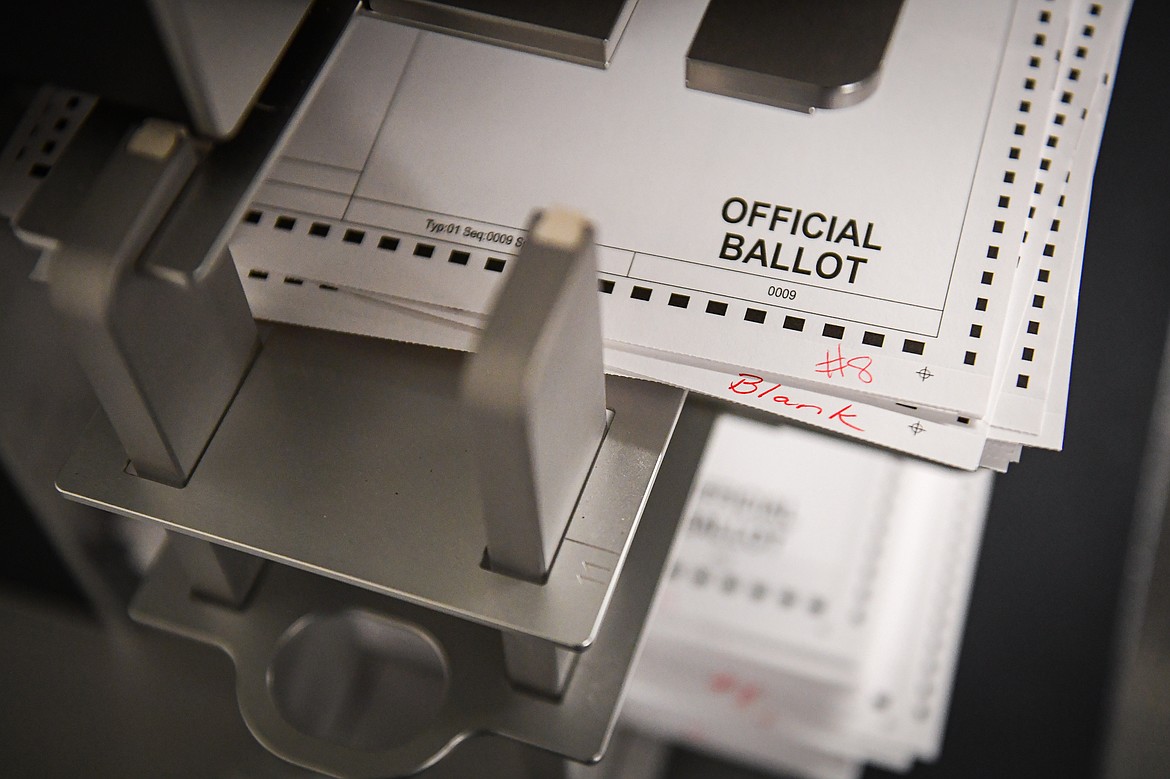
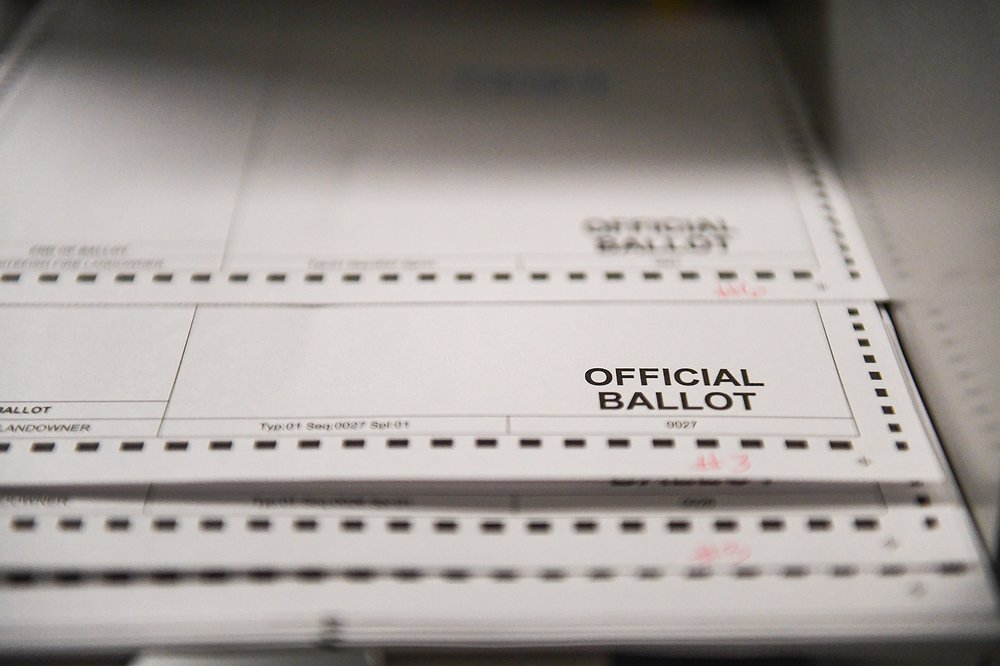
Test ballots are entered into a vote tabulator during a a public viewing test for the 2026 Special and School District Election at the Flathead County Election Department in Kalispell on Thursday, April 23. (Casey Kreider/Daily Inter Lake)
Casey Kreider
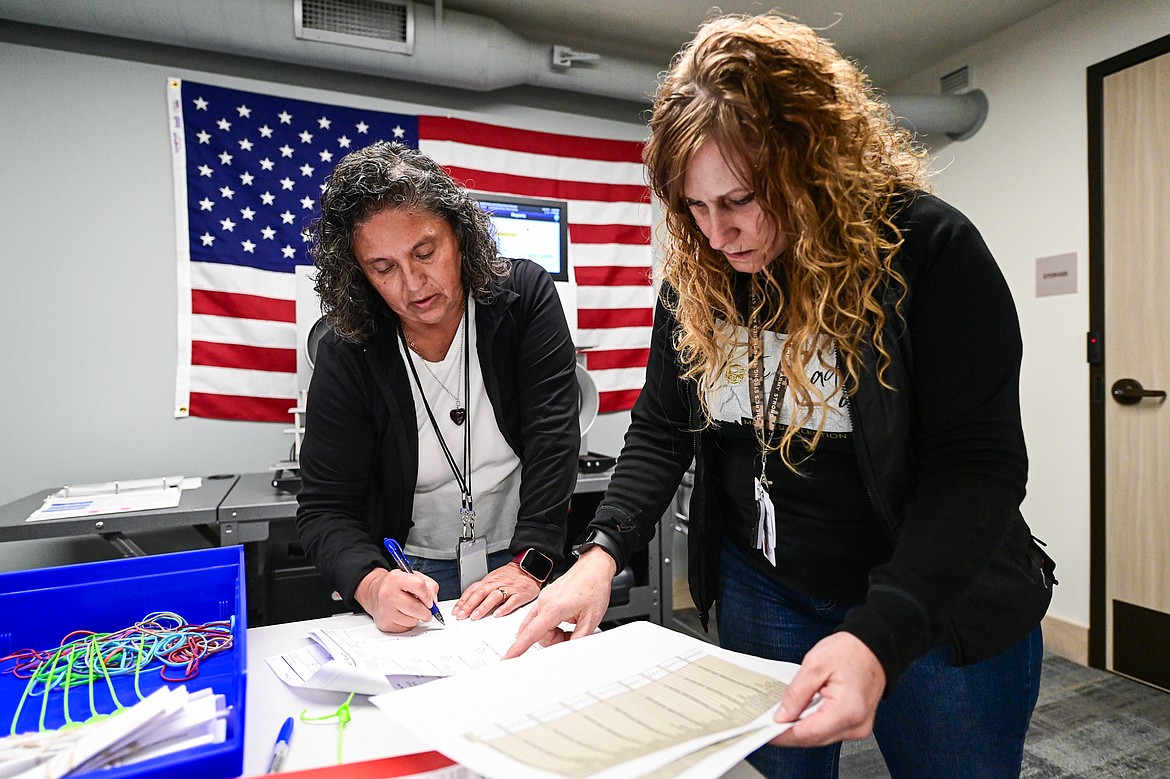
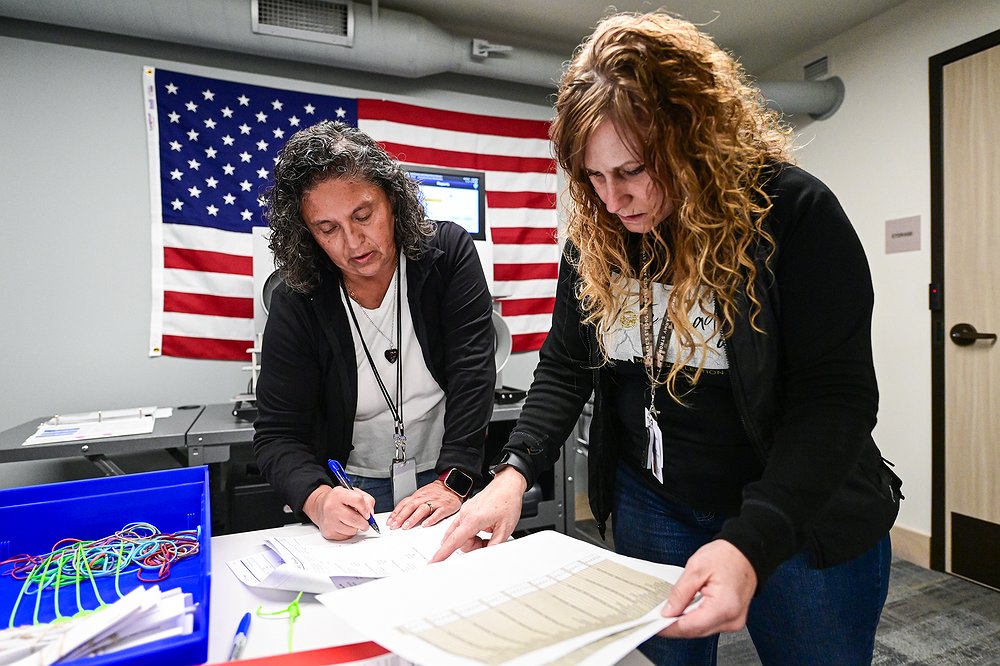
Tammy Bartos, left, and Paula Buff check the results of a batch of test ballots tabulated during a public viewing test for the 2026 Special and School District Election at the Flathead County Election Department in Kalispell on Thursday, April 23. (Casey Kreider/Daily Inter Lake)
Casey Kreider
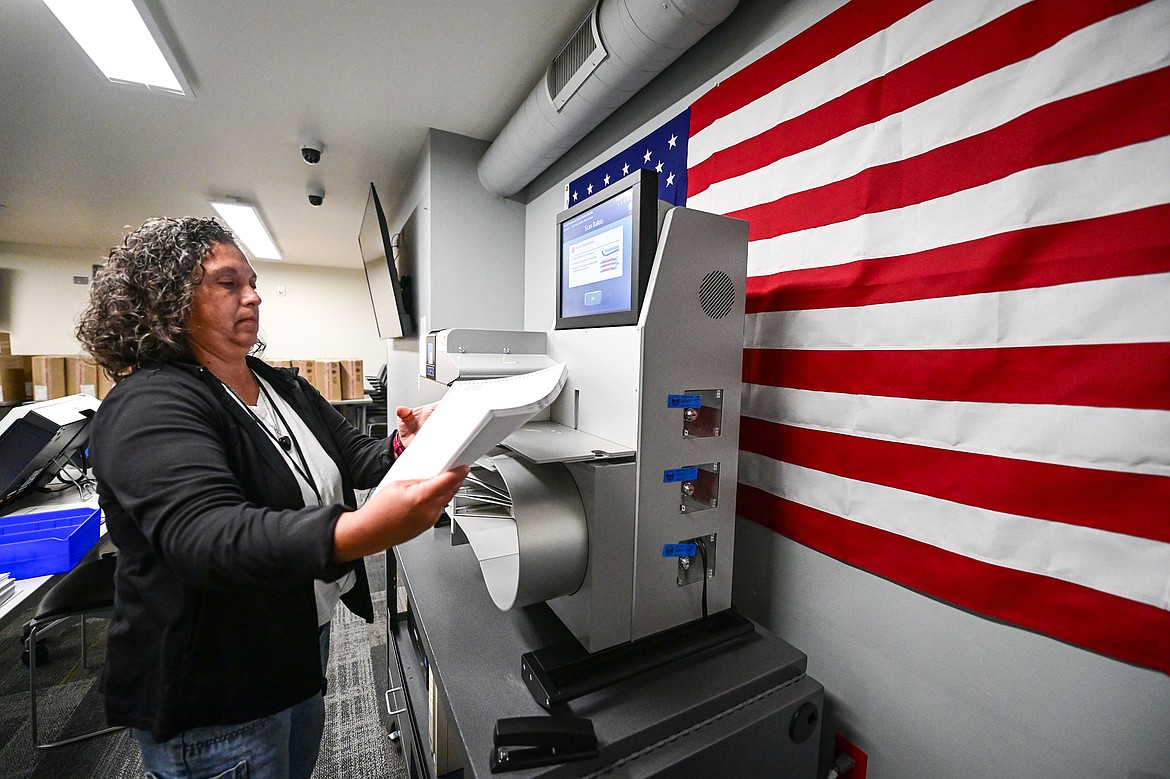
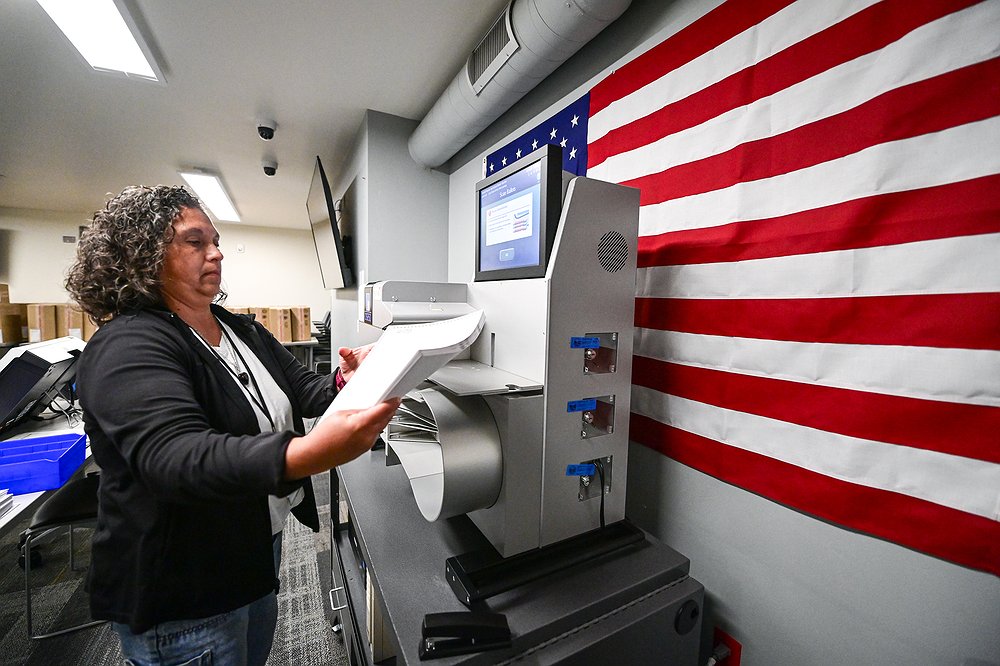
Tammy Bartos places a stack of test ballots into a vote tabulator during a public viewing test for the 2026 Special and School District Election at the Flathead County Election Department in Kalispell on Thursday, April 23. (Casey Kreider/Daily Inter Lake)
Casey Kreider
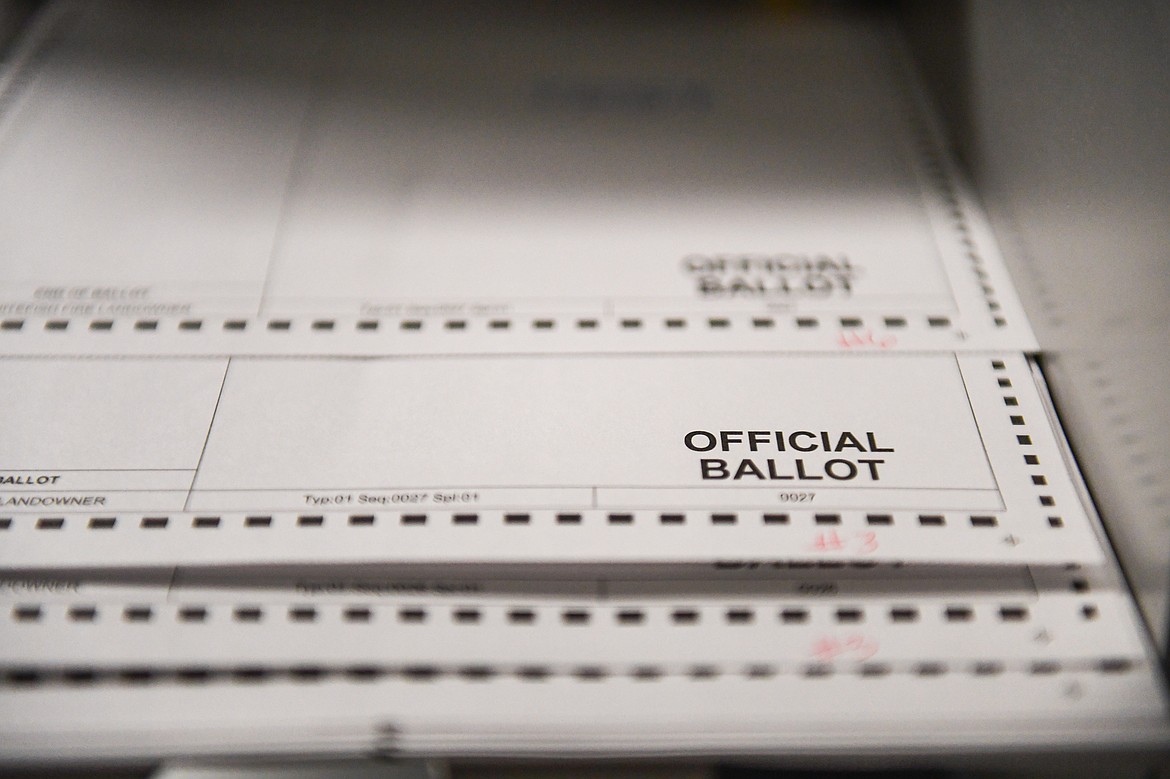
Test ballots are entered into a vote tabulator during a a public viewing test for the 2026 Special and School District Election at the Flathead County Election Department in Kalispell on Thursday, April 23. (Casey Kreider/Daily Inter Lake)
Casey Kreider
The conference room of the Flathead County Elections Department whirred with noise. Volunteers rattled off strings of numbers to the beat of keyboards tapping and staplers clicking.
Along one wall, a machine the size and shape of an industrial copier droned a constant tsch, tsch, tsch as it shuttled through ballots at blinding speed. The tabulator scanned each ballot and recorded how many votes had been cast for each candidate in a report that volunteers then printed off and read out loud to the recorder.
“It’s just like a giant calculator that happens to count ballots,” said Paula Buff, the elections administrator for Flathead County. “It doesn’t have any personal feelings, personal biases or political opinions. All it does is what it’s programmed to do, and that is read bubbles.”
While the makes and models have changed over time, tabulators have been a staple of elections departments across the country for decades.
Flathead County owns four tabulators made by the state-certified elections equipment company Elections Systems and Software, of which two are typically used to count ballots for special district elections. For the June 2 primary election, when as many as 85,500 registered voters could cast a ballot in Flathead County, all four machines could easily come into play.
Buff said the tabulators allow the department to wade through the influx of ballots and post elections results within 24 hours of the polls closing. Flathead County’s tabulators count about 4.5 ballots every second.
By comparison, Buff said it took a team of about 30 staff and volunteers three days to hand count 6,652 ballots collected during the 2022 primary election in Lincoln County. A slight printing error rendered the absentee ballots unreadable for the county’s tabulators, and the Secretary of State’s Office told Buff, who headed the county’s elections department at the time, that both in-person and absentee ballots had to be counted using the same method. Her team worked from 7 a.m. to 8 or 9 p.m. every day to return results as quickly as possible.
“It took forever. Forever,” emphasized Buff. “If we were to hand count in Flathead County, it would easily take us two solid weeks.”
The tabulators also reduce the likelihood of human error and ensure elections results are accurate. All machines undergo rigorous testing before being used. Staff and volunteers mark a stack of test ballots equal to about 10% of the expected voter turnout. The ballots are run through the tabulators, and staff compare the machine counts with a hand count performed earlier.
“We have the answer, and we’re asking the tabulator the question,” said Buff. “If, for some reason, it’s not right, then we go back and audit and look at all of the different ballots and try to figure out if it was a marking error on our part. Or, if it is, in fact, a tabulator issue, maybe there was an oval that wasn’t filled in quite enough, something like that."
That’s exactly what Buff suspected happened on April 23, when elections officials tested two of the county’s four tabulators ahead of the school board elections. One of the machines counted 19 votes for a candidate that was supposed to have 20 votes. The number of test ballots with an undervote, meaning the voter had not filled in a vote for all positions, had also ticked up by one.
“That’s real interesting because I ran it this morning and we proceeded and it was fine,” said Buff as she looked over the tabulator’s report. “It’s doing something wonky.”
She suspected the ink on one of the ballots had faded after so many cycles through the machines. Sifting through the 348 test ballots, staff pulled out a few with smudged marks that Buff believed the machine could have had trouble picking up on.
“We’ll run it again,” she said. “If it doesn’t come up with 20, we’ll run it again. If it doesn’t come up with 20, I’m going to throw it down the stairs.”
That was, perhaps, a slight exaggeration, but any machine that repeatedly returned questionable results would be pulled from the election day lineup until the problem was diagnosed and fixed. Luckily, a second test of the machine returned the correct results. Buff still wasn’t satisfied.
“Yes, it worked,” she said as she doublechecked the freshly printed report against her spreadsheet. “Let’s run it one more time just to make sure it’s going to be consistent.”
After clearing a few more tests, Buff determined the tabulator was, in fact, accurate. Both machines would also be tested again on the morning of May 4, before staff and volunteers began counting the real ballots.
In her five-year career as an elections administrator, Buff said she has never encountered a true error with a tabulator. The machines are programmed to separate any ballots that cannot be read, and Buff said most issues are easy to sort out.
A tabulator will only count ballots from one precinct at a time, for example, so any ballots filed in the incorrect precinct will be automatically redirected into a separate tray. Volunteers need only tuck the ballot into the correct pile for it to be counted. Other times, ballots get stuck together or need to be flattened before being put back through the tabulator.
Occasionally, a tabulator will be unable to read a ballot because the voter improperly filled out the document. They might have marked down a vote for two candidates, when they were only supposed to vote for one, or marked their vote with an “x” rather than filling in the entire circle as instructed.
“That’s where the resolution board comes into play,” said Buff.
The three-person board reviews questionable ballots and makes the final determination on how the ballot should be counted. The board is also charged with reviewing ballots cast for write-in candidates.
The tabulators are not connected to the internet, making any outside interference in ballot counting nearly impossible. Buff uses an encrypted USB drive to transfer data from the tabulators to a hardened laptop with special encryption software. The laptop has also never been connected to the internet.
Buff uses the state’s reporting software to compile the county’s election results on the hardened laptop. She then uses another USB drive to transfer the compiled data to her typical work computer to upload the results.
The multi-step process consumes about 40 USB drives every election.
“We blow through an awful lot of memory sticks,” said Buff. “The reason for that is because none of these things are connected to the internet and none of them can be. And, once you pull results off of the tabulator and put it in the elections system laptop, that stick is done. You can’t use it again.”
That’s because all physical ballots, memory sticks and computer files must be retained for at least 22 months after an election.
Montana law mandates that elections administrators randomly audit 10% of each county’s precincts within nine days of a federal election. Ballots from the selected precincts are hand counted and compared with the results provided by the tabulators. Any discrepancies are investigated and must be explained to the Secretary of State’s Office as a voter, machine or election official error. If a discrepancy of greater than 0.5% is found and cannot be explained, the machines used to count the votes are removed from service and additional precincts in the county are audited via hand counting.
After the initial audit, Buff said all elections materials are sealed away in the county’s records facility. After 22 months have elapsed, the ballots are shredded, and the memory sticks are sent to the elections equipment company to be wiped clean and sanitized of all data so they can be reused in another election cycle.
Buff acknowledged that the ballot counting process seems perplexing from an outside perspective. That’s why she invites community members interested in the elections process to visit the department with questions.
“Education is key. You can come down here and watch the process, and I think that’s beneficial,” said Buff. “I really don't think that there’s anybody on the planet other than the people who have worked in elections departments who even has an idea of the level of security checks, verifications and all of that that goes into it.”
All four of the county’s tabulators will be tested at least twice leading up to the federal primary election on June 2. Tests are open to the public. Dates and times for tests will be posted on the Elections Department’s website.
Reporter Hailey Smalley can be reached at 406-758-4433 or hsmalley@dailyinterlake.com. If you value local journalism, pledge your support at dailyinterlake.com/support.
 Tammy Bartos, left, and Paula Buff check the results of a batch of test ballots tabulated during a public viewing test for the 2026 Special and School District Election at the Flathead County Election Department in Kalispell on Thursday, April 23. (Casey Kreider/Daily Inter Lake)
Casey Kreider
 Tammy Bartos places a stack of test ballots into a vote tabulator during a public viewing test for the 2026 Special and School District Election at the Flathead County Election Department in Kalispell on Thursday, April 23. (Casey Kreider/Daily Inter Lake)
Casey Kreider
 Test ballots are entered into a vote tabulator during a a public viewing test for the 2026 Special and School District Election at the Flathead County Election Department in Kalispell on Thursday, April 23. (Casey Kreider/Daily Inter Lake)
Casey Kreider