
Kalispell Public Schools board reorganizes, gets budget update
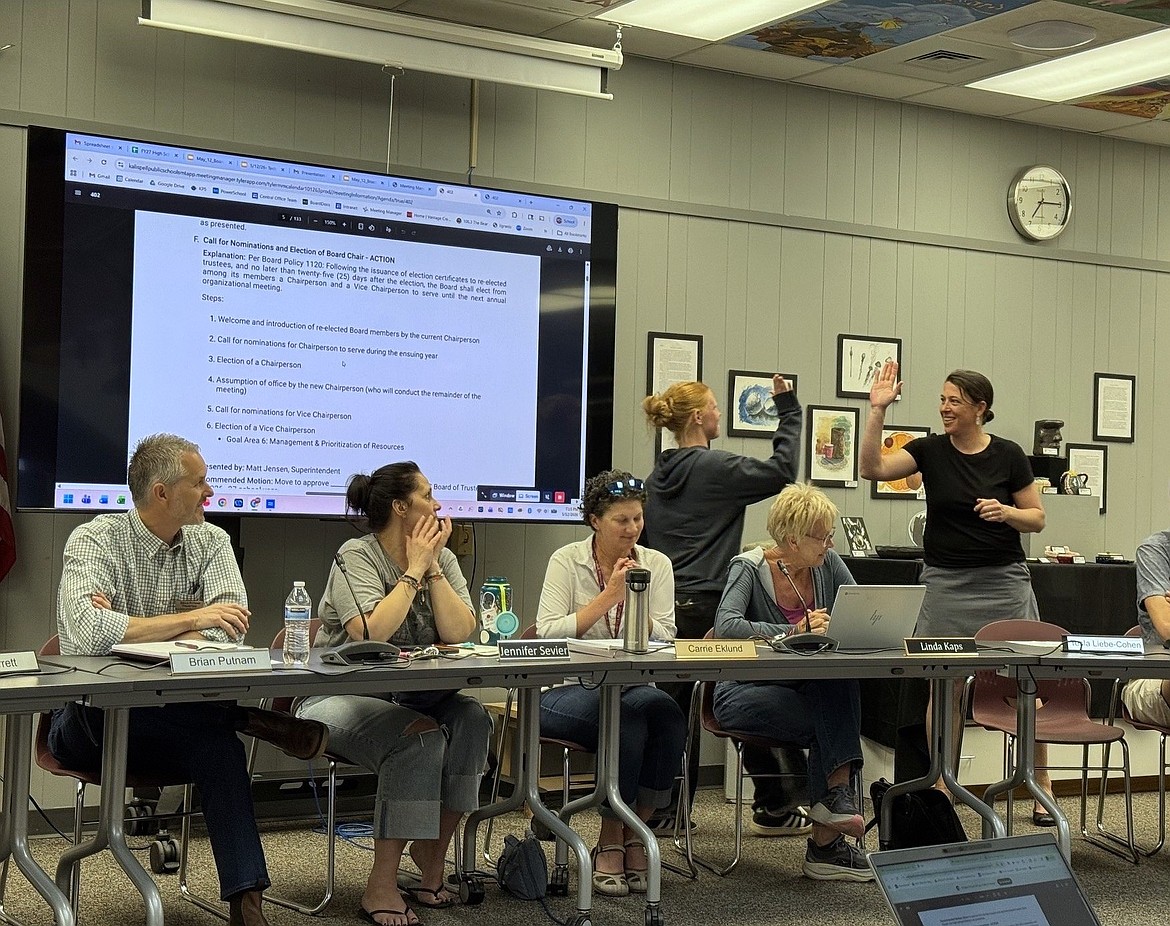
Kalispell Public Schools board of trustees chairwoman, Jinnifer Mariman, gives a high five to its first student representative, Glacier High School sophomore Tesla Liebe-Cohen. (Daily Inter Lake)
The Kalispell Public Schools Board of Trustees selected new leadership, welcomed a student representative and reviewed the budget following school elections last week.
Trustees selected Jinnifer Mariman as the new chair as part of the board’s May 12 reorganization. She previously served as vice chair. Trustee Heidi Hickethier was selected as the new vice chair.
Before passing the gavel, outgoing Chair Scott Warnell thanked the board and commended the work of Superintendent Matt Jensen and Assistant Superintendents Sara Cole and Peter Fusaro.
“I just really want to take the opportunity to thank all of you. I’ve learned a ton from all you guys the six years I’ve been on the board," Warnell said.
New board members include high school district Trustee Rich Terrett, who will represent Olney-Bissell, Pleasant Valley, Smith Valley and West Valley schools. Elementary Trustee Thomas Hollo was seated by acclamation in an uncontested race.
Glacier High School sophomore Tesla Liebe-Cohen was seated in the new student representative role, receiving a couple of high-fives on her way to an open chair at the board table.
The student representative is an unelected, informal advisory position. The board invited students to apply. Thirteen applications were received and five students were interviewed.
"This is something we’ve been looking forward to for quite some time and wanting to do it in a thoughtful way.” Mariman said.
The student representative will have access only to publicly available materials and will be excluded from executive sessions and confidential matters.
“It’s a nonvoting position, but it’s a way to have a student voice on our board,” Mariman said.
Liebe-Cohen said she plans to gather student input through surveys and forums.
“I recognize how important communication between students and administrators is. The school board has done a great job integrating KPS solutions that benefit our student community, however the student position on the board is an incredible step forward in furthering the student voice,” Liebe said in an email to the Inter Lake after the board meeting.
“When hearing about the opportunity, I knew that KPS deserved a representative who would speak up for them and I plan to do just that. I couldn’t be more excited to join a board of truly impressive trustees who have shown me an incredibly warm welcome,” she said.
THE BOARD also received a budget update from district Business Director Chris Campbell after Kalispell voters rejected a $1.1 million elementary general fund levy in the May 5 election.
“Going into the election, our elementary budget was sitting at about $650,000 in the red with all of the costs that we’re carrying forward. The biggest contributing factor to that is that our year-over-year revenue growth ... is $320,000, whereas our expenses are increasing by about $940,000. The biggest piece of that is just steps [pay increases based on years of service] on everybody’s salary schedule,” Campbell said.
Meanwhile, the high school budget has a projected surplus.
“As of right now, we’re projecting that high school will finish with a surplus of $648,000. What that current number does not include, however, is any changes to salary schedules that take place during negotiations. Each percentage negotiated, however that’s distributed, would cost precisely $200,000,” Campbell said.
Variables affecting these projections include union negotiation outcomes, health insurance open enrollment, federal funding allocations (expected in July) and salary placement for new hires.
“So, without the levy and that deficit number, we kind of circled back and started looking at any cuts that we could make that had been baked into that budget already,” he said.
To reduce the deficit, proposed cost-saving measures include shifting $100,000 from the elementary district’s general fund to the technology fund, where revenue is being generated by a 10-year, $1,087,000 elementary technology levy that Kalispell voters approved in May 2024.
“[The] second piece that we pulled out of the budget was $90,000 of non-salary budgets. We have not increased our non-salary budgets,” Campbell said. “Every school gets an allocation for operating in their building and the HR department has to pay certain fees for background checks and different things along those lines. We cut $90,000 out of those types of departmental budgets that aren’t related to salaries."
The third proposed component would shift how districtwide positions are paid for. Those positions include business, information technology, maintenance and facilities staff, and superintendents. Historically, Kalispell Public Schools has split the cost of those districtwide positions between the elementary and high school districts. Instead of a fixed split, Campbell proposed aligning the percentages with the districts’ state funding, which is tied to enrollment, resulting in a split that puts more of the cost burden on the high school district.
"So, like I said, we had been at $650,000, pulling those three levers gets us down to about $230,000 of a deficit that we’re sitting at now,” he said, going into the 2026-27 school year.
To pay for critical infrastructure projects at elementary schools, Kalispell Public Schools applied for a $2.3 million intercap loan at an estimated 4.5% interest rate over 15 years. The impetus for the loan was a catastrophic system failure at one school this winter that led to a day of canceled classes. If awarded, the priority project will be converting the heating systems at Hedges and Russell elementary schools to hydronic systems.
IN OTHER agenda items, Technology Director Eric Miletich outlined early plans to move schools to a one-to-one device program while phasing out desktop computer labs. He said some desktops will be retained for classes that require them.
Each student will be issued a dedicated laptop to provide equitable access to an essential classroom tool.
The district has been moving in this direction for a while, Miletich said. With many classrooms already equipped with Chromebook sets, costs will be negligible, according to Miletich and Assistant Superintendent Peter Fusaro.
Miletich said the move will not cut costs but will create some long-term financial efficiencies. Chromebooks typically have a five- to seven-year replacement cycle, he said. The information technology department plans to create a downcycling plan, such as setting aside older devices as loaners if a student forgets to bring a laptop to school.
Similar to textbook policies, fees for repair or replacement would be instituted. The district has proposed a four-tier system ranging from $25 for basic repairs to $400 for device replacement. Miletich said officials will work on a fee scale for families whose students qualify for free and reduced lunches, which are determined by income.
As part of the one-to-one initiative, the district will have student interns work on devices and provide tech support to their peers.
Reporter Hilary Matheson can be reached at 406-758-4431 or hmatheson@dailyinterlake.com. If you value local journalism, pledge your support at dailyinterlake.com/support.