
Whitefish examines plan to manage city’s deer population
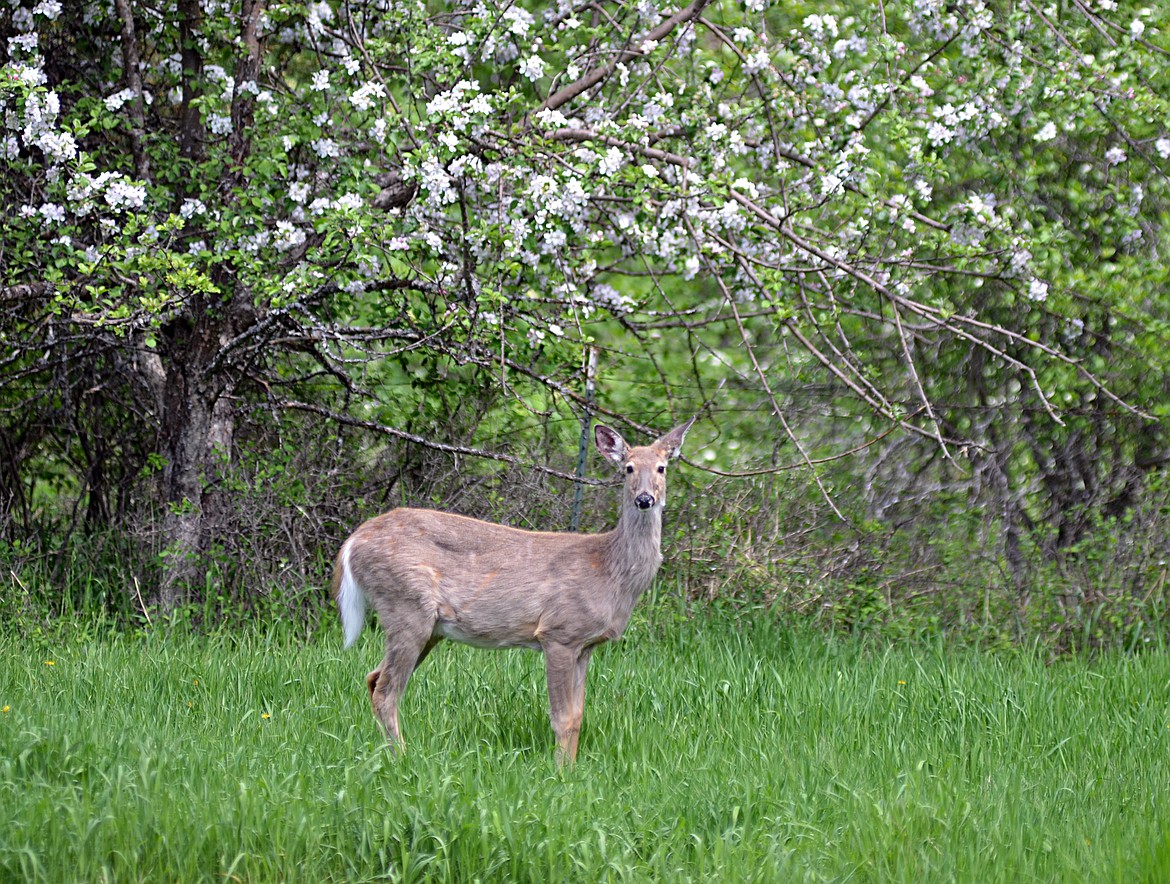
A deer stands on the edge of the James Bakke Nature Reserve.(Heidi Desch/Whitefish Pilot FILE)
Deer have long been a fixture of downtown and residential areas of Whitefish. But as the city has grown and the deer population has increased, so have conflicts, including damage to landscaping and collisions with vehicles.
Whitefish City Council, during a work session on Monday, is set to discuss a deer management plan. The high number of deer in the city can create an environment that threatens human safety, damages property and is not conducive to the long-term health of the deer population or its habitat, the plan says.
The work session begins at 5:30 p.m. at City Hall, 418 E. Second St. The regular meeting begins at 7:10 p.m.
Managing deer has been a topic of conversation for at least a half dozen years, but this year Council adopted a goal of reviewing and establishing a plan to monitor the city’s population.
Whitefish Police Department and Montana Fish, Wildlife and Parks conducted a deer assessment in 2023, but that resulted in minimal numbers leading to an inconclusive mitigation assessment. This led the state wildlife agency to suggest contracting with a private company to complete further population studies.
Conversations reemerged last year when chronic wasting disease was found in a buck at the Flathead County Landfill. The fatal neurological disorder affects ungulates, including deer, and spreads through animal-to-animal contact and environmental contamination. One of the ways to limit the spread of the disease is through population control.
For the city’s plan, the goal is to eliminate individual deer that threaten human safety or property. And to reduce the potential for human-deer interactions and conflicts by lowering the deer density within the city.
Aggressive deer and those that are causing severe and persistent damage to landscaping could be dispatched as determined by the Whitefish Police Department, according to the draft plan. Education and outreach would also be part of the plan to remind residents not to feed deer, along with renewing focus on enforcement of the state law that makes it a misdemeanor to feed deer.
Whitefish could also choose to trap and dispatch deer to reduce the overall deer density as determined through Fish, Wildlife and Parks.
THERE ARE three public hearings on the agenda. Council is set to vote on ordinances amending its zoning and subdivision regulations as part of ongoing updates under the Montana Land Use Planning Act.
It will also hold a hearing on a request for a tax exemption for a property at 1550 W. Lakeshore Drive. State law allows for property tax benefits during the construction and five years following for an existing building undergoing remodeling, reconstruction or expansion.
For the benefit to apply, the Montana Department of Revenue must determine that the taxable value will increase by at least 2.5%. It was unable to do so for the West Lakeshore Drive property, and thus the state and city staff are recommending Council deny the request.
Council is set to vote on a bond resolution for the first phase of its water tank project to provide additional water storage on the south side of town. The city is using just under $6.3 million in loan funding for the $8.4 million project.
A vote is set to change city code to reflect changes to the city’s Planning Commission under the Montana Land Use Planning Act. The commission will no longer review subdivision plats and won’t have the authority to grant variances.
Council will entertain a request from Habitat for Humanity of Flathead Valley to provide $250,000 in funding for the organization to purchase lots at 1958 and 1966 Whitefish Ave. to build two affordable townhomes. The city has funds available from the resort tax fund.
During a work session at 6:30 p.m., Council will discuss an update to the sustainable tourism management plan.
Deputy Editor Heidi Desch can be reached at 406-758-4421 or hdesch@dailyinterlake.com. If you value local journalism, pledge your support at dailyinterlake.com/support.