
Kalispell Council reviews $189M budget proposal, weighs public safety and infrastructure spending
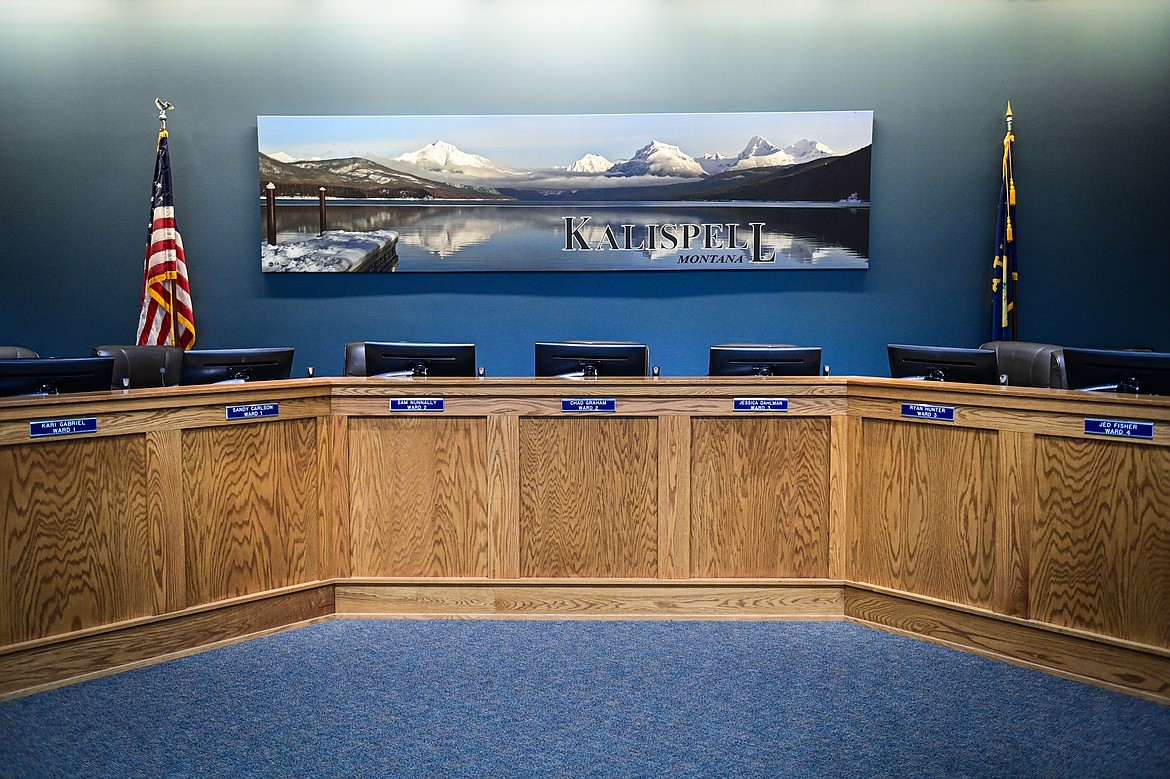
Kalispell City Council chambers in City Hall on Wednesday, April 3. (Casey Kreider/Daily Inter Lake)
Casey Kreider
Kalispell City Council took its first look at the municipality’s proposed fiscal year 2027 budget last week.
Council mulled over the $189.2 million financial roadmap during work sessions on Monday and Wednesday night. Departments heads from Public Works, Police, Fire, Development Services and Information Technology each presented their plans for the upcoming fiscal year.
During the review, councilors discussed hiring a communications manager, strengthening parking enforcement downtown and moving forward on a community recreation center.
The city’s general fund expenditures are projected to reach about $17.8 million, funded primarily by property taxes. City Manager Jarod Nygren said revenue could take a hit from recent changes to the state property tax system, which reduced the burden on lower-cost residential homes last year.
Because Kalispell’s housing market is primarily lower-cost residential homes, Nygren said that the city lacks enough high-cost second homes to make up for the anticipated loss in tax revenue.
“This obviously will affect our revenues pretty dramatically in the city, especially with the number of housing units coming on,” Nygren said.
Officials allocated $6.8 million from the city’s voter-approved public safety levy in fiscal 2027, which will cover new lifesaving equipment and emergency vehicles for the Kalispell Fire Department as well as continue paying the salaries of 11 police officers and 12 firefighters hired over fiscal year 2025.
The new hires in the Fire Department reduced response times from nearly 10 minutes to about seven minutes, according to Fire Chief Jay Hagen.
“It’s reducing our need to rely on our neighbor agencies like Evergreen or Smith Valley,” Hagen said.
The levy is also helping fund construction of Kalispell’s third fire station, which is expected to be operational by summer 2028. Hagen said he plans to add funding in the budget for two new firefighters to staff the station once it's built.
The budget includes new lifesaving equipment, such as a $20,000 Stryker LUCAS device that delivers continuous chest compressions during transport to the hospital. A new defibrillator, costing $60,000, was also included.
The Police Department budgeted $70,000 for license plate recognition software. Nygren said the system will help two dedicated officers more efficiently enforce downtown parking limits.
“It was pretty easy to avoid enforcement,” Nygren said, referring to the traditional method of chalking tires, which had been undertaken by a parking enforcement officer who has since retired.
Under the new system, enforcement would be handled by a dedicated parking employee and a special services officer, who would also serve as the animal warden and code enforcement officer.
Police Chief Jordan Venezio said that the license plate reader system is not connected to the criminal justice network and only records the license plate number, type of vehicle and the duration it's been in the same spot.
COUNCILORS APPEARED willing to give themselves a slight pay bump to keep up with other cities. Nygren said that there is room in the budget to do so.
“It’s not a huge adjustment. It certainly would get the Council a lot closer to being where other comparable cities [are] and the city budget certainly can handle that,” Nygren said.
Councilor Jed Fisher supported a pay raise last year and reiterated his argument that it could encourage more people to run for office.
“I want the single young lady to be able to run and be able to manager her costs,” he said. “I don’t think money is always it, but I do think we need to keep up.”
Councilor Kari Gabriel has served on Council since 2003 and said she never received a raise.
“I think it is inappropriate that it has stayed stagnant for six terms with one council member,” Fisher said.
Because some councilors were uncomfortable voting on their own raise, they considered delaying the increase until after the next election.
Mayor Ryan Hunter recommended creating a formula to stay aligned with market rates while limiting annual raises to 3-4%.
Councilors make around $5,000 a year, and the mayor makes about $9,000.
COUNCILOR WES Walker introduced the idea of hiring a communications officer. He said that while campaigning, many constituents told him the city needs to improve communication with the public.
City Clerk Aimee Brunckhorst serves as Kalispell’s communications officer, but councilors appeared willing to split her job up.
“You’re doing two full time jobs,” Walker said to Brunckhorst. “The city has gotten big enough that we need a full-time communication [officer].”
“We need to realize that we’re not going to be the smallest big city in Montana forever,” Councilor Kyle Waterman agreed.
After a routine water main flushing failed and caused multiple breaks in April, Councilor Sam Nunnally said the city should have done a better job keeping the public informed.
“The information that came out didn’t come out right away,” Nunnally said.
Nygren said that a full-time position likely could not be squeezed into the fiscal year 2027 budget, but deemed it worthy of further discussion.
PUBLIC WORKS Director Susie Turner reviewed her department’s budget, which includes several capital projects to improve the city’s sewage, water and stormwater systems.
The water main under Claremont Street, from Conway Drive to Ryder Road, will be repaired and enlarged at a cost of about $720,000. Another water main along part of Second Avenue West will also be repaired, with an estimated cost of $1.5 million.
Turner said that the budget for fire hydrants increased from $15,000 to $25,000 because frequent hit-and-run damage leaves the city footing the bill for repairs.
“Our hydrants get hit a lot,” she said.
The budget also includes a new street sweeper funded through the stormwater and street fund.
WHILE DEVELOPING the Parks and Recreation department’s master plan, the city heard from many residents who want a community recreation center. Some councilors on Wednesday expressed interest in allocating $20,000 for a feasibility study to evaluate how possible the project was
“We don’t have a lot of recreational opportunities,” said Fisher. “I think it’s time to progress this thing forward a step.”
Some councilors were hesitant, however.
“Let’s take care of what we have,” Nunnally said.
Hunter noted that previous efforts to garner funding for a recreation center have fallen short, making him reluctant to spend money on a study.
Although the proposed budget is $7 million higher than last year, Nygren said the city spends far less than the budgeted amount. Of last year’s $181 million budget, about $60 million has actually been spent.
“And the reason is, you have these huge capital projects that sometimes take two to three years to come to fruition,” Nygren told councilors.
Reporter Jack Underhill can be reached at 406-758-4407 or junderhill@dailyinterlake.com. If you value local journalism, pledge your support at dailyinterlake.com/support.