
Collaborative effort brings bear-resistant trash cans to downtown Bigfork
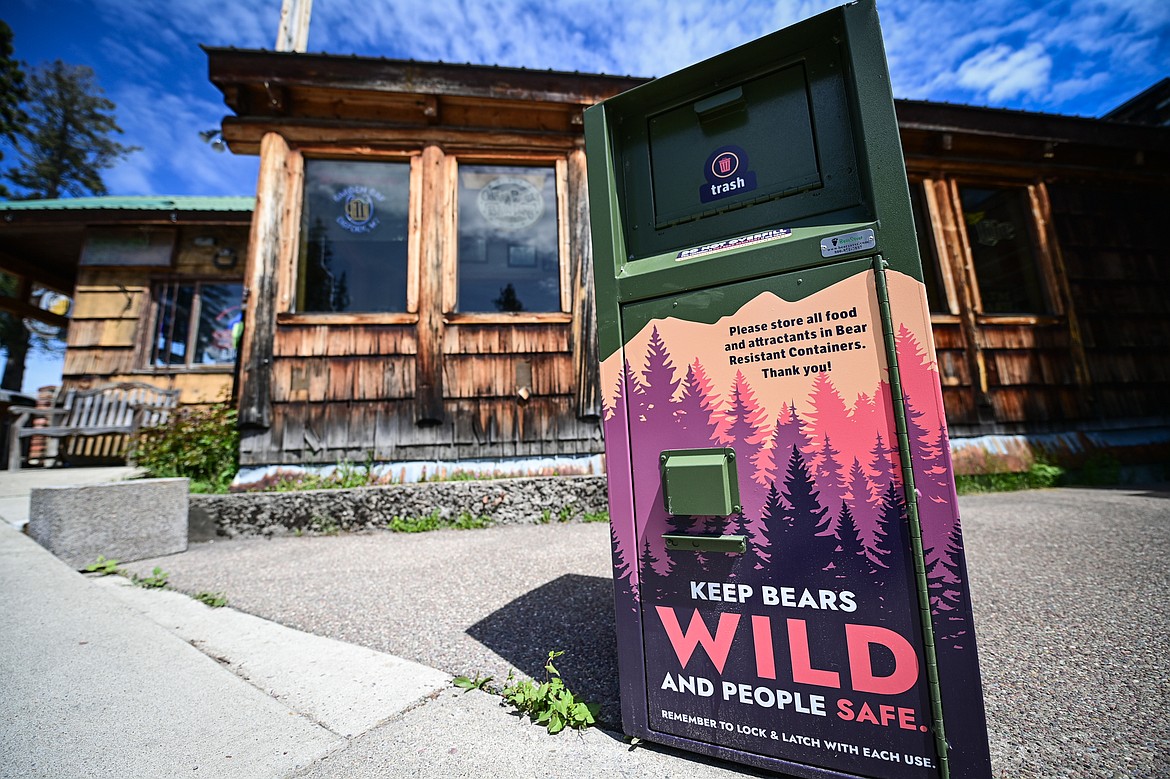
A bear-resistant waste receptacle in Bigfork on Friday, May 22. (Casey Kreider/Daily Inter Lake)
Casey Kreider
Luke Lamar recalls an incident a few years ago when Montana Fish, Wildlife and Parks trapped a grizzly bear, not deep in the backcountry of the Bob Marshall Wilderness, but wandering around the gift shops of downtown Bigfork’s Electric Avenue.
The bear was presumably traveling between the mountains and Flathead Lake along a historic grizzly bear corridor and was tempted away from the ripe chokecherries and serviceberries along the river by the promise of another reward: the open-top garbage cans scattered around the downtown streets. One man’s trash is another bear’s lunch.
Despite the fact Bigfork is situated along one of the most populous grizzly bear regions in the Lower 48, until this month, downtown Bigfork did not have bear-resistant trash cans.
Dedicated community groups are working to change that.
This month, six new bear-resistant trash cans wrapped with an alpenglow-inspired design that reads “Keep Bears Wild and People Safe,” were installed in town. A seventh is planned for Sliter Park.
The cans are the result of a collaborative effort between three organizations. Community Foundation for a Better Bigfork coordinated the project after recognizing a need to improve bear safety in downtown Bigfork. Swan Valley Connections, of which Lamar is the managing director, donated the cans. People and Carnivores, a Bozeman-based nonprofit that promotes coexistence between humans and large carnivores, contributed to the wrap design and installation.
Swank Enterprises also joined in on the project and installed the trash cans as a donation to the community.
“This is an encouragement to remember that we are in the wilderness and that we are in the bears’ home and that we are responsible for what we train bears to do,” said Community Foundation for a Better Bigfork Vice President Chiaveli Locsin-D'souza. “It serves as a reminder for everyone to respect the nature that we’re in.”
Garbage is the main cause of conflicts with bears in Region 1, a designation given to Northwest Montana by Fish, Wildlife and Parks. Both Lamar and Ryan Wilbur, the Kalispell-based Bear Smart Community Program Coordinator for People and Carnivores, reiterated this point: reducing access to trash will reduce conflicts with bears.
“We want to be proactive as bears are moving into some of these areas where we haven't seen grizzly bears before,” said Lamar. “Being proactive about getting some trash cans in place before conflict happens is kind of the ideal scenario.”
Today, more than 1,000 grizzly bears roam the Northern Continental Divide Ecosystem, a vast 9,600-acre swath of land that includes the Bob Marshall Wilderness, Mission Mountains and Glacier National Park. It constitutes the largest population of grizzly bears in the contiguous United States and is effectively in Bigfork’s backyard.
But it wasn’t always that way, and Lamar said even locals are surprised to learn Bigfork is situated in a grizzly bear corridor between the Swan Mountains and Flathead Lake. Historically, bears from the Swan Valley traveled along the rivers in search of ripe berries, but as grizzly bear populations declined throughout the 20th century, this became less common, and the iconic bear was relegated to T-shirts and coffee mugs in Bigfork gift shops.
“Most folks are kind of surprised to learn that there are grizzly bears, potentially in Bigfork proper, but then on the outskirts as well,” said Lamar. “I talk to folks who think, ‘Oh, the bears are only up in the mountain, right? And they don't come down in the valley bottom?’ Which, of course, is not true. I talk to folks who think that grizzly bears are only back in the Bob Marshall Wilderness. Most folks are surprised to learn that there could be a grizzly bear on Electric Avenue, for example.”
According to Lamar, there was a time the upper Swan Valley was considered a “grizzly bear mortality sink.”
“Bears were getting into trouble around people's homes and getting into uncontained attractants and were getting habituated to food,” he explained. “That's when scary things happen, and that's when those bears get removed by agency managers sometimes. And there were also malicious poaching happening, and very low tolerance levels of bears at that time.”
This mirrored national attitudes towards grizzly bears. Prior to the 1800s, an estimated 50,000 grizzly bears roamed throughout the entirety of the American West. As settlers arrived, they viewed the bears as threats to human safety. Efforts to shoot, poison and trap the apex predator successfully reduced the population to only 700 bears in 2% of their original range by 1975.
That same year, grizzlies were officially recognized as an endangered species, and in 1993, U.S. Fish and Wildlife Service developed a recovery plan for the species and identified six ecosystems still able to support the bears, including the Northern Continental Divide Ecosystem.
But laws did little to change how humans interacted with bears. When Swan Valley Connections formed in 2007, grizzly bear populations were increasing, and as their range expanded into areas now occupied by humans, there was a parallel increase in conflict between the two species. Unsecured trash and other attractants taught bears to view humans as a food source. These problem bears had to be removed or euthanized, which worked counter to efforts to restore grizzly bear populations.
In response, Swan Valley Connections began to educate residents about safely living alongside bears. The organization loans out bear resistant trash cans to locals for free, and to date has provided more than 500 cans. Swan Valley Connections’ experts work with landowners to construct electric fences to secure small livestock, orchard trees and other attractants. They also offer free property consultations to residents to brainstorm ways to secure other on-property attractants before they result in a bear conflict.
“We've made a lot of effort, not just in the local Bigfork area, but across Montana in general,” said Lamar. “Those conservation strategies over the past few decades have led to expanding grizzly bear populations, but also because of those expanding populations, bears are moving into areas where we haven't seen bears for a very long time, since they were essentially exterminated."
In downtown Bigfork, the new trash cans may seem like a small step, but wildlife experts say they are a crucial part of the strategy to ensure bears and humans are able to thrive alongside each other in the coming years.
For more information about bear safety in Bigfork, visit bigfork.org/bear-in-mind.